Hand Beading on Knitwear
Two hand-beaded samples show how floral clusters and a statement neckline can be developed on wool and wool-cashmere knitwear.
S01
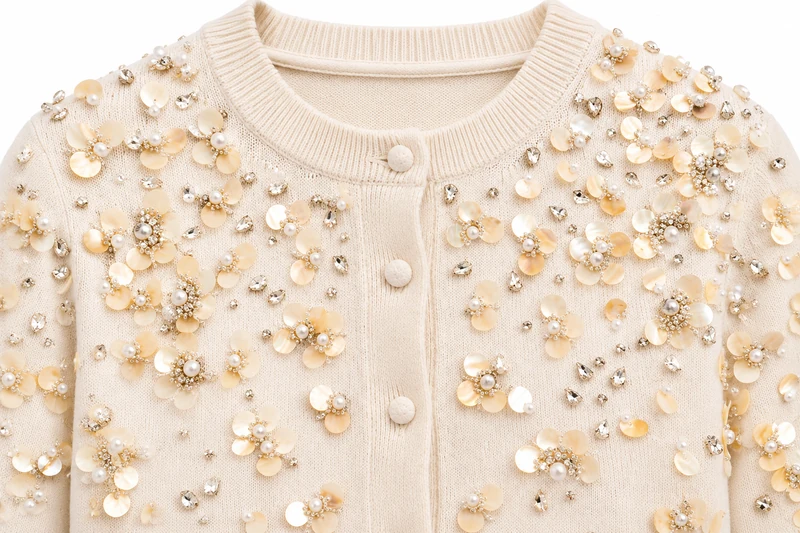
Pearl and Floral Beading on a 14GG Wool Cardigan
Pearl-like beads, champagne-coloured floral pieces and crystal-like accents form raised clusters on an ivory cardigan knitted in 2/48, 100% Victoria Wool.
The size and distribution of the clusters affect how the fine-gauge fabric supports the embellishment.
S02
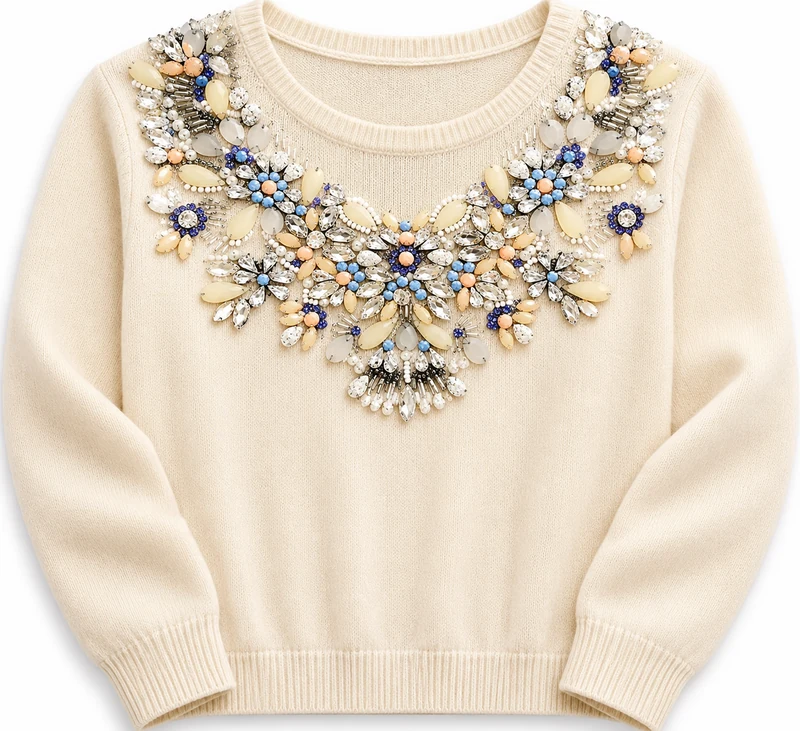
Statement Neckline on Wool-Cashmere Knitwear
Round, oval and elongated components follow a curve from the shoulders to the centre front of a 12GG crew-neck sweater. The 2/26 base yarn is 90% wool and 10% cashmere.
The development work considers the weight and attachment of the components around the neckline and how the knit moves underneath.
Technical Development Considerations
The 14GG cardigan spreads floral clusters across the shoulders, fronts and sleeves while keeping the button fastening relatively clear. Trial securing methods for the different components and check whether their combined weight pulls or compresses the knit.
For the neckline sample, set a placement reference and review each component for weight, edge finish, attachment and care compatibility. Compare neckline shape and movement before and after embellishment, with particular attention to the ribbed opening.
Selected FAQs
How can manufacturers prevent neckline distortion caused by embellishment?
Neckline distortion can be reduced by carefully planning the decorative area, attachment points and distance from the ribbed neckline. Heavy components should not create unnecessary tension around areas that need to stretch during dressing. During sampling, the neckline should be checked before and after embellishment, including its extension, recovery and appearance. The final attachment construction should be confirmed through a physical wear and movement assessment.
How do you check the durability of hand-applied embellishments?
Durability should be assessed through attachment checks, component pull tests, snagging assessments and suitable care testing. The test method needs to reflect the actual component materials and attachment construction. Sharp edges, loose threads, surface damage and colour transfer should also be examined. For designs with multiple decorative components, each type should be assessed individually rather than assuming that one test result applies to the entire embellishment.
Develop with us
Have a detail
in mind?
Share a reference, a material or an effect you would like to explore. We can help develop a direction for your knitwear.
Discuss Your ProjectExplore our development process ↗