Fine-Gauge Jersey Knit
Smooth single-bed fabric for lightweight layers.
Technical Overview
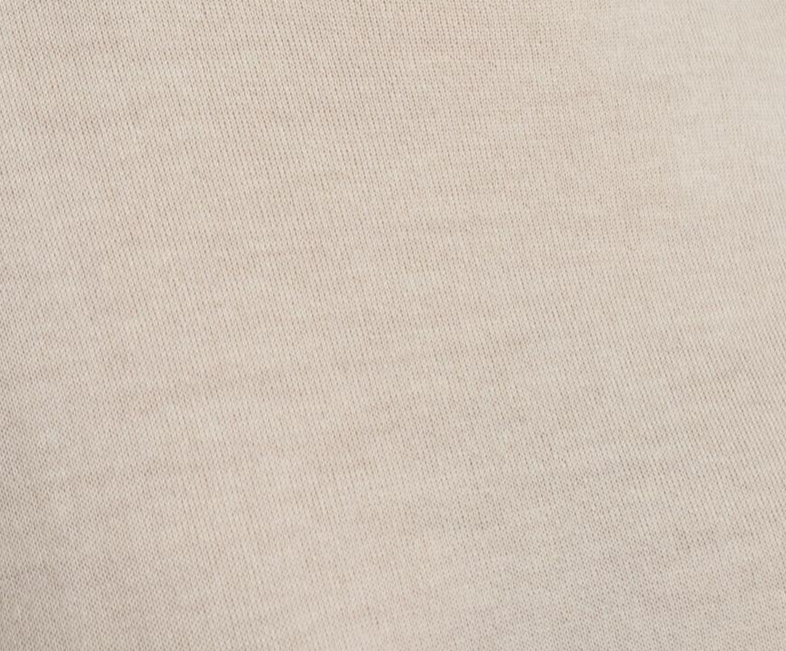
Single Jersey is a weft-knitted structure formed by a single needle bed. The needles create successive rows of interconnected loops, known as courses, while the vertical columns of loops are called wales.
The face side has a relatively smooth appearance, with the characteristic V-shaped knit loops. The reverse side shows the curved or looped portions of the stitches.
This difference between the two sides is one of the defining characteristics of Single Jersey.
Construction & Variations
Fine-Gauge Jersey
Fine-Gauge Jersey is produced using finer machine gauges and yarn specifications appropriate to the intended construction.
The finer needle arrangement allows a more delicate stitch appearance and supports lightweight knitwear with a refined surface.
It is particularly relevant to fine wool sweaters, cashmere knitwear, lightweight cardigans and minimalist designer collections.
Plated Jersey
Plated Jersey uses two yarns fed in a controlled arrangement so that each yarn occupies a particular position within the knitted structure.
This technique can be used to explore different fibre combinations, surface appearances and colour effects.
The result depends on yarn characteristics, feeding arrangement and machine settings. It should not be confused with ordinary colour-changing or jacquard knitting.
Yarn and Gauge Considerations
Machine Gauge
Machine gauge refers to the number of needles per inch on the needle bed.
A higher gauge generally indicates a finer needle arrangement, while a lower gauge indicates a coarser arrangement.
However, machine gauge alone does not determine fabric thickness or weight. Yarn diameter, stitch length and fabric density must also be considered.
Yarn Composition and Yarn Count
Wool, cashmere, cotton, viscose, silk and blended yarns can all be considered for Single Jersey development.
Their behaviour differs in softness, strength, elasticity, drape, moisture response and finishing compatibility.
Yarn count should be evaluated together with the machine gauge and intended stitch length. A yarn that is suitable for one gauge may not produce the desired fabric coverage or surface appearance at another gauge.
Documented development samples
The development notes document a 3GG wool-blend jersey with metallic-effect yarn, a 12GG cashmere jersey in 2/26 Nm and a 16GG wool jersey in 2/60 Nm.
Garment Applications
Gauge Selection for Different Product Characters
Machine gauge is one of the first decisions in jersey development.
A 3GG construction can create a visibly coarse stitch appearance, while 12GG and 16GG constructions allow progressively finer stitch arrangements.
A coarse-gauge wool-blend sweater may be designed around a relaxed silhouette, while a 16GG wool garment may be developed as a lightweight layering piece.
Minimalist Luxury Through Yarn Selection
A simple jersey construction can be used for premium knitwear when the yarn, stitch definition and finishing are carefully selected.
Fine wool and cashmere are particularly relevant for this direction.
The design does not necessarily need complex surface decoration. A clean neckline, balanced proportions, suitable fabric weight and consistent surface appearance can be more important.
Development & Quality Considerations
Fabric Spirality and Garment Twisting
The knitted fabric or finished garment develops a diagonal distortion. Side seams may move towards the front or back after washing.
Yarn twist and residual torque, uneven knitting conditions, fabric relaxation and finishing tension can all contribute to spirality.
Yarn characteristics should be reviewed before bulk knitting. Fabric relaxation and finishing conditions should be checked during sample development. Garment spirality should be assessed after the intended washing process, not only when the garment is first taken off the machine.
Dimensional Changes After Washing
The garment becomes shorter, wider, narrower or otherwise changes shape after washing and finishing.
Fibre relaxation, stitch length, fabric density, yarn composition and finishing conditions all influence dimensional stability.
Measure fabric dimensions before and after relaxation. Establish washing and finishing trials using the intended care conditions. Confirm garment measurements after processing before approving bulk production.
Selected FAQs
What is the difference between Single Jersey and Double Knit?
Single Jersey is formed on one needle bed and has a distinct face and reverse side, with a natural tendency to curl at free edges. Double Knit uses two needle beds to form a more balanced double-bed structure. The two constructions differ in surface appearance, thickness, elasticity and dimensional behaviour.
How does machine gauge affect Single Jersey knitwear?
Machine gauge determines the spacing of the needles and influences the possible stitch fineness. A finer gauge can support a more delicate stitch appearance, while a coarser gauge produces more visible stitches. The final fabric also depends on yarn diameter, stitch length and density.
Which yarns are suitable for Fine-Gauge Jersey?
Fine-Gauge Jersey can be developed using fine wool, cashmere, merino wool, cotton, viscose and suitable blended yarns. The choice depends on the intended softness, weight, drape, strength and garment application. Yarn suitability should be confirmed through knitting trials.
How can designers create different textures using Single Jersey?
Designers can introduce knit-and-purl patterns, plated yarn arrangements, speciality yarns, engineered stitch variations and selected combinations with other structures. These methods create tonal patterns, decorative surfaces and different levels of texture while retaining jersey as the main construction.
Why does Single Jersey fabric curl at the edges?
Single Jersey has an inherent tendency to curl because of the structural imbalance between the face and reverse sides of its knitted loops. The degree of curling depends on yarn, stitch length, fabric construction and finishing. Suitable ribbed edges or other planned edge constructions can help control it.
How can manufacturers prevent Single Jersey garments from twisting or shrinking after washing?
Manufacturers should evaluate yarn twist, feeding tension, stitch length, fabric relaxation and finishing conditions. Washing trials and dimensional measurements should be carried out during development. The approved garment should be checked after the intended washing process before bulk production.
Develop with us
Have a detail
in mind?
Share a reference, a material or an effect you would like to explore. We can help develop a direction for your knitwear.
Discuss Your ProjectExplore our development process ↗