Pointelle Knit
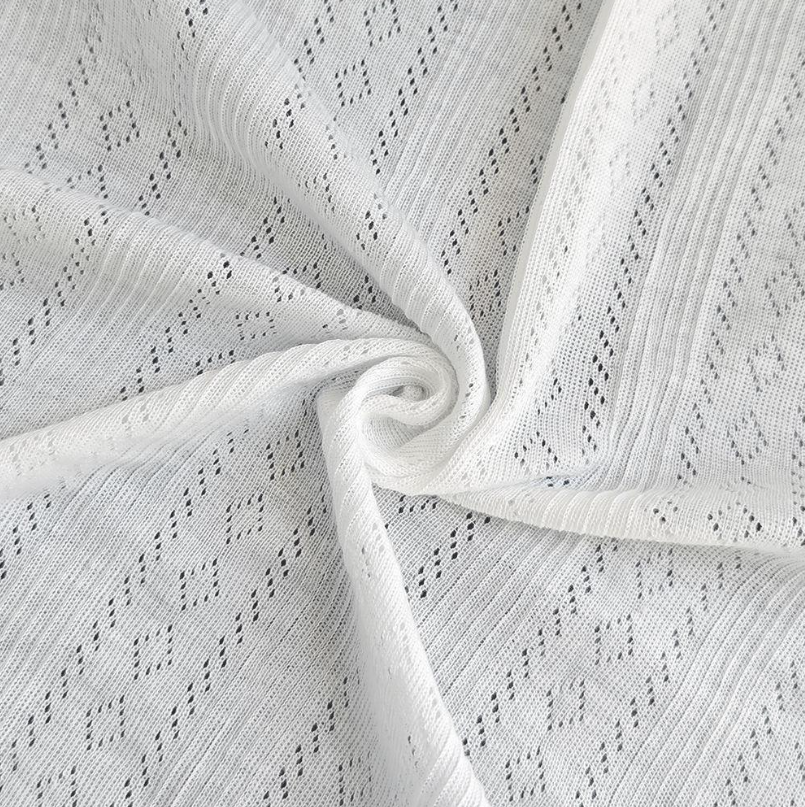
Small transferred eyelets create controlled transparency.
Technical Overview
Pointelle is a family of decorative openwork knitting structures that use controlled stitch movements to create small openings within a knitted fabric.
A common machine-knitting method involves transferring a stitch from its original needle position to an adjacent needle. This changes the arrangement of the surrounding loops and leaves an opening in the fabric structure.
Depending on the knitting sequence, additional techniques may be used to stabilise the surrounding stitches and maintain the intended pattern.
Construction & Variations
Single Eyelet Pointelle
Single Eyelet Pointelle uses individual openings arranged at regular intervals.
The holes may be positioned vertically, horizontally or diagonally across the fabric.
This is one of the simplest ways to introduce controlled transparency into a knitted garment.
Vertical Pointelle
Vertical Pointelle arranges eyelets into continuous or repeated vertical lines.
This creates a directional pattern that can visually elongate the garment.
The structure is particularly useful for cardigans, knitted dresses and fitted tops.
Diamond Pointelle
Diamond Pointelle combines eyelets into repeated diamond-shaped motifs.
The openings can be positioned around a central point to form a geometric pattern.
This construction is commonly associated with delicate vintage-inspired knitwear but can also be adapted for contemporary designer collections.
Yarn and Gauge Considerations
Machine Gauge and Eyelet Scale
Machine gauge influences needle spacing and the scale of the knitted construction.
Fine gauges can support smaller and more delicate Pointelle patterns, while coarser constructions can produce larger openings and more visible decorative arrangements.
However, eyelet size is also influenced by the number of transferred stitches, the transfer distance, stitch repeat and yarn characteristics.
Yarn Composition and Strength
Wool, cotton, viscose and suitable blended yarns can be considered for Pointelle development.
Fine wool blends may provide a soft hand feel for lightweight sweaters and cardigans.
Cotton blends can be suitable for summer products, while viscose blends may introduce greater drape.
Garment Applications
Fine Pointelle for Lightweight Summer Tops
Small and closely arranged eyelets can be used to develop lightweight summer tops and fine-gauge sweaters.
The openings provide a subtle visual texture while maintaining a relatively compact fabric appearance.
This works particularly well with cream, ivory, natural white and pale beige yarns.
Pointelle with Solid Jersey Panels
Pointelle can be combined with solid Single Jersey to create controlled areas of transparency.
For example, the main body can use jersey while the sleeves or upper chest feature Pointelle.
Alternatively, a Pointelle centre panel can be surrounded by plain jersey sections.
Development & Quality Considerations
Dropped Stitches and Unintended Laddering
An eyelet becomes an uncontrolled opening, or stitches begin to run vertically from the intended pattern.
Incorrect transfer sequences, unsecured loops, damaged needles or excessive stress around the opening.
Check that transferred stitches are properly secured by subsequent knitting actions. Inspect the surrounding loops and test the structure under light stretching. Evaluate the finished fabric for unwanted laddering.
Eyelet Distortion After Washing
The holes become larger, smaller or irregular after washing, changing the appearance of the original pattern.
Yarn relaxation, fabric stretching, unsuitable washing conditions and differences in the stability of open and compact areas.
Conduct washing trials using the intended care conditions. Measure the eyelets before and after washing. Establish the finished dimensions and pattern appearance using the approved washed sample.
Selected FAQs
What are the different types of Pointelle Knit?
Common variations include Single Eyelet Pointelle, Double Eyelet Pointelle, Vertical Pointelle, Diamond Pointelle, Lace-Inspired Pointelle and Micro Pointelle. They differ in eyelet size, spacing, pattern repeat and overall surface appearance.
What is the difference between Pointelle and general openwork knitting?
Pointelle generally refers to small, controlled and repeated eyelet patterns within a knitted structure. General openwork can include much larger openings, more extensive transparent areas and more complex arrangements of solid and open fabric sections.
How are Pointelle holes created on computerized knitting machines?
A common method is to transfer a stitch from its original needle position to an adjacent needle. This changes the loop arrangement and creates an opening. The surrounding stitches are then knitted according to the programmed sequence to stabilise the pattern.
Can Pointelle be used for lightweight summer sweaters and cardigans?
Yes. Fine Pointelle is suitable for lightweight summer tops, cardigans, knitted dresses and layering garments. The yarn, gauge and opening size should be selected according to the intended level of transparency, comfort and durability.
Why do Pointelle holes become distorted after washing?
The openings may change shape because of yarn relaxation, fabric stretching, washing conditions and differences between open and compact areas. Washing trials should be conducted using the intended care process, and eyelet dimensions should be checked before and after finishing.
How can manufacturers prevent Pointelle from snagging or losing stitches?
Manufacturers should control stitch transfers, surrounding loop stability, yarn quality and eyelet size. The finished fabric should be checked for loose yarn sections and unsecured loops. Snagging assessments are useful for garments intended for frequent wearing.
Develop with us
Have a detail
in mind?
Share a reference, a material or an effect you would like to explore. We can help develop a direction for your knitwear.
Discuss Your ProjectExplore our development process ↗