Intarsia Knit
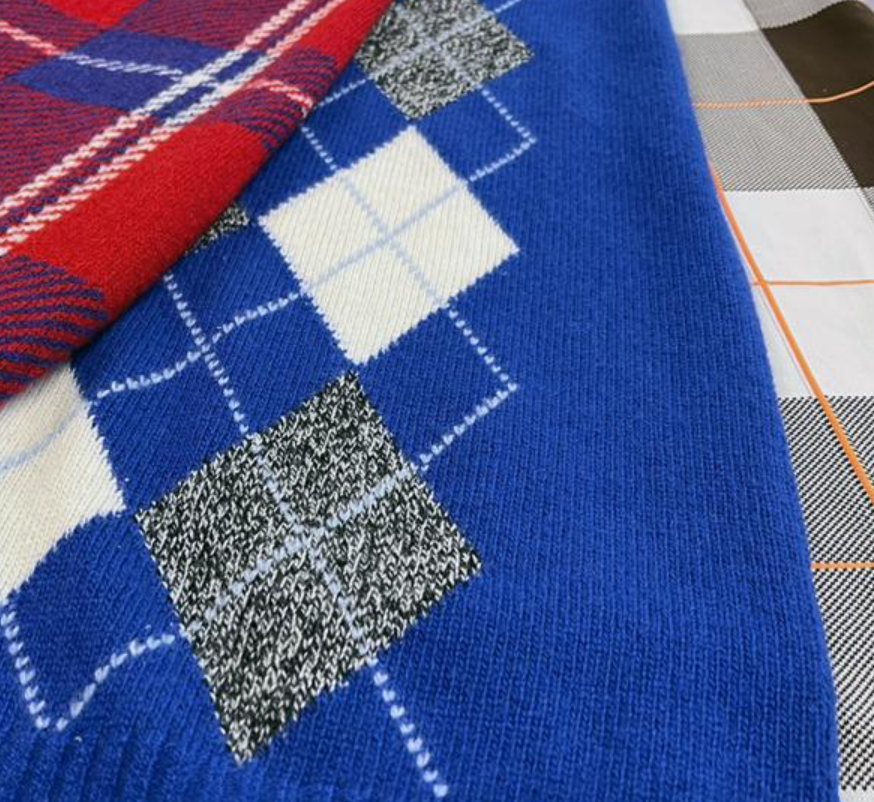
Separate yarn carriers form distinct knitted colour fields.
Technical Overview
Intarsia is a method of creating separate colour fields within a knitted fabric.
Each colour field is supplied by its own yarn carrier. The yarn knits only within the designated area and returns to the next course without being carried across unrelated colour fields as a conventional Jacquard float.
At the boundary between two colours, the adjoining yarns must be connected through a suitable knitting sequence.
Construction & Variations
Two-Colour Intarsia
Two-Colour Intarsia uses two separate yarn supplies to create adjoining colour fields.
Typical designs include large geometric divisions, diagonal colour blocks, contrast panels and simple abstract shapes.
The two colours can be sharply contrasting or selected from a similar tonal range.
Geometric Intarsia
Geometric Intarsia uses clearly defined shapes such as diamonds, rectangles, triangles, squares and diagonal blocks.
The shapes can be arranged symmetrically or developed as an irregular composition.
Argyle-inspired knitwear is a familiar example of geometric Intarsia, where diamonds and diagonal lines form a repeated colour arrangement.
Directional and Diagonal Intarsia
Colour fields can be arranged vertically, horizontally or diagonally.
Diagonal divisions can create movement across the garment, while vertical blocks can emphasise length and proportion.
The direction can continue from the front body into the sleeves or be deliberately interrupted at the garment seams.
Yarn and Gauge Considerations
Machine Gauge and Colour Detail
Machine gauge influences the size of the knitted loops and the smallest practical details within a colour design.
Fine gauges can support smaller colour transitions, while coarser gauges are more suitable for larger blocks and simplified graphics.
However, the clarity of the design also depends on yarn thickness, stitch density, colour contrast and the shape of the motif.
Yarn Composition and Compatibility
Wool, cotton, cashmere and suitable blended yarns can be considered for Intarsia.
The selected yarns should have compatible knitting and finishing characteristics.
Different fibre compositions may react differently during relaxation and washing.
Garment Applications
Large Geometric Colour Blocks
Large colour blocks can be arranged across the front, back or sleeves.
Examples include diagonal divisions, asymmetric rectangles, oversized diamonds and contrasting shoulder panels.
The design can use two colours for a restrained appearance or three to four colours for greater visual contrast.
Oversized Graphic Motifs
Large graphic shapes can be knitted directly into the fabric.
Examples include abstract symbols, oversized initials, simplified artwork and stylised brand graphics.
Unlike embroidery or surface printing, the colour becomes part of the knitted structure.
Development & Quality Considerations
Holes at Colour Boundaries
Small holes or open gaps appear where two colour areas meet.
Incorrect yarn overlap, unsuitable boundary stitch sequences, insufficient yarn capture or unstable loop connections.
Check the boundary construction and yarn interaction. Use an appropriate tuck, overlap or other approved joining sequence according to the machine programme. Inspect both sides of the sample, particularly at narrow colour transitions.
Yarn-Carrier Interference and Tangling
Yarn carriers or yarn supplies interfere with one another during knitting.
Poor carrier positioning, unsuitable parking positions, overlapping carrier paths or excessive yarn movement.
Review the carrier sequence and travel paths before knitting. Use suitable Intarsia yarn-carrier arrangements and machine-specific programming. Check the sequence carefully when several colour fields are present within one course.
Selected FAQs
What are the common types of Intarsia Knit designs?
Common design directions include two-colour geometric patterns, three-colour arrangements, multi-colour graphics, Argyle-inspired diamonds, abstract colour blocks, placement motifs and irregular artistic compositions.
What is the difference between Intarsia and Jacquard?
Intarsia uses separate yarn supplies for individual colour fields, so unused colours are not normally carried across large areas of the reverse. Jacquard uses programmed colour selection, with inactive yarns managed through floats or a knitted backing. Intarsia is particularly suitable for larger separate colour areas, while Jacquard is commonly used for repeated and distributed colour patterns.
Why is Intarsia suitable for large colour blocks?
Each colour can be supplied independently within its own area. This avoids carrying unused colours across large sections of the reverse and can reduce unnecessary yarn consumption and fabric bulk.
Can Intarsia use more than three colours?
Yes. Intarsia can use multiple colours. The practical difficulty depends on the number of separate colour fields within each course, yarn-carrier availability, carrier movement and machine programming. More colours do not automatically mean greater difficulty if the colour areas are well organised.
Why do holes appear between Intarsia colour blocks?
Holes may develop when adjacent colour fields are not properly connected. The cause can involve yarn overlap, boundary stitch formation, carrier positioning or an unsuitable knitting sequence. The colour joins should be checked on both sides of the physical sample.
How can manufacturers reduce yarn tangling during Intarsia production?
The colour fields and yarn-carrier movements should be planned before knitting. Suitable carrier positioning, parking sequences and machine-specific Intarsia programming help reduce interference. Simplifying unnecessary small colour areas can also improve production efficiency.
Develop with us
Have a detail
in mind?
Share a reference, a material or an effect you would like to explore. We can help develop a direction for your knitwear.
Discuss Your ProjectExplore our development process ↗