
Case Study CS09 · Hand embroidery
Three-Colour Argyle Cardigan with Mohair Hand Embroidery
Reviewed by VIAKNIT Technical Development Team
Add raised mohair embroidery while preserving the proportions of a three-colour diamond pattern.
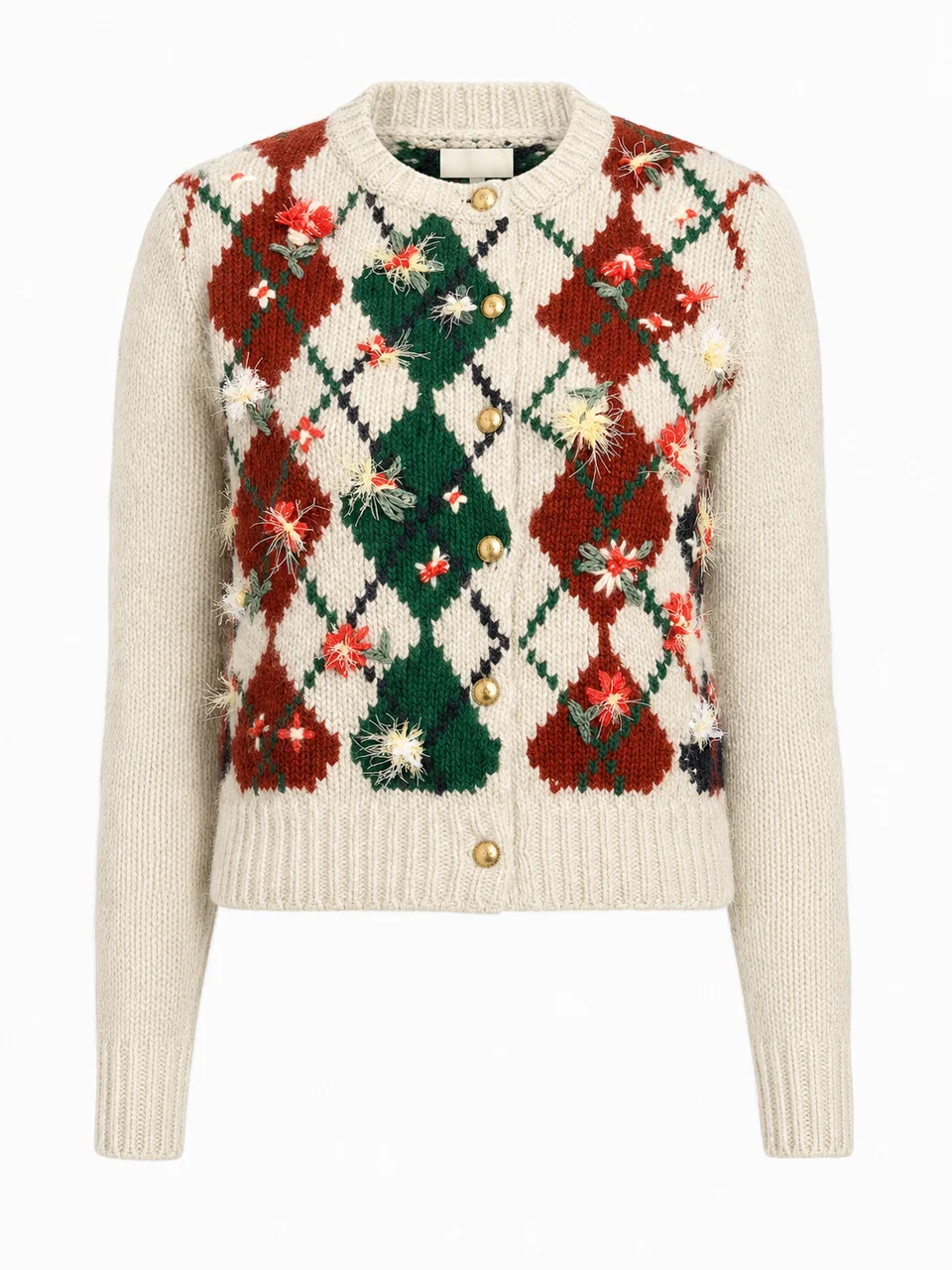
Developing a distinctive designer cardigan often requires more than selecting an attractive yarn or reproducing a traditional knitting pattern. The real challenge is bringing together yarn characteristics, knitted structures, colour placement and decorative craftsmanship in a way that maintains both visual quality and garment stability.
This VIAKNIT development case study focuses on a three-colour Argyle cardigan originally developed for an independent design team's Autumn/Winter collection.
The design combines a traditional diamond pattern with a textured knitted surface and locally applied three-dimensional floral embroidery. The main colour combinations are ivory, forest green and burgundy, creating three different interpretations of the same vintage-inspired design.
The proposed yarn direction was MORO 2/26, consisting of 70% wool and 30% cashmere.
Unlike a conventional Argyle cardigan, this design also incorporates raised floral embroidery using mohair yarn. The embroidery adds depth and texture but introduces additional considerations involving fabric stability, local weight, stitch density and washing performance.
The original design was supplied as a reference image rather than a complete Tech Pack.
VIAKNIT's development approach therefore started with interpreting the visual concept and translating it into practical technical requirements, including yarn evaluation, gauge selection, pattern construction, embroidery trials and garment sampling.
The proposed knitting gauge was 5GG–7GG, with the final selection dependent on yarn characteristics, stitch structure and physical sample evaluation.
The objective was to develop a cardigan that retained the character of traditional Argyle knitwear while introducing a more distinctive combination of colour, texture and hand-crafted decoration.
Project Background: Reinterpreting Traditional Argyle Knitwear
The project originated from an independent design team developing an Autumn/Winter collection.
The designer wanted a cardigan with a recognisable vintage character but a more distinctive visual identity than a standard diamond-pattern sweater.
Three design elements defined the direction.
Traditional Argyle Diamond Pattern
The main body features a multi-colour diamond arrangement using ivory, forest green and burgundy.
The pattern needs to remain visually balanced across the front and back panels, particularly around the shoulders, side seams and centre-front opening.
Textured Knitted Construction
The design explores multi-colour knitting techniques to create clear colour boundaries and maintain the intended diamond proportions.
The technical development needed to consider both Jacquard and Intarsia construction, as these methods have different implications for reverse-side appearance, yarn consumption, fabric thickness and production efficiency.
Three-Dimensional Floral Embroidery
Raised floral embroidery using mohair yarn provides the main decorative feature.
Rather than covering the entire garment, the embroidery is concentrated around selected areas of the front and sleeves.
This allows the Argyle pattern to remain the dominant visual element while the flowers introduce additional texture and craftsmanship.
The three colour versions were developed to explore different brand aesthetics.
| Colour Version | Design Character |
|---|---|
| Ivory | Warm, vintage-inspired and refined, highlighting the floral embroidery |
| Forest Green | A deeper Autumn/Winter direction with a Heritage aesthetic |
| Burgundy | Stronger visual character for an independent designer's signature piece |
The three versions were not intended to be simple colour substitutions.
The proportions of ivory, green and burgundy within the diamond pattern also needed to be evaluated so that all three garments belonged to the same collection while maintaining their individual character.
Yarn Selection and Technical Specifications
Material selection was an important part of the development process.
The proposed main yarn was MORO 2/26, with a composition of 70% wool and 30% cashmere.
This blend was considered for its balance of wool structure and cashmere softness.
The designer also considered Merino wool blends, cashmere blends and other yarn options capable of producing the desired textured appearance.
The main development specifications were as follows.
| Specification | Project Direction |
|---|---|
| Product | Three-Colour Argyle Cardigan |
| Collection | Autumn/Winter |
| Proposed Main Yarn | MORO 2/26 |
| Yarn Composition | 70% Wool / 30% Cashmere |
| Proposed Gauge | 5GG–7GG |
| Main Pattern | Three-Colour Argyle / Diamond |
| Knitting Techniques | Jacquard and Intarsia Evaluation |
| Decorative Yarn | Mohair |
| Embroidery | Localised 3D Hand Embroidery |
| Main Colours | Ivory, Forest Green, Burgundy |
| Neckline | Round Neck |
| Closure | Front Button Opening |
| Cuffs and Hem | Rib Construction |
| Buttons | Vintage Gold-Tone Buttons |
The final gauge and knitting construction needed to be confirmed through physical knitdowns.
This is particularly important because the same yarn can produce different fabric thickness, weight, elasticity and surface appearance at different machine gauges.
For this project, the 5GG–7GG range provided a starting point for evaluating the desired substantial yet comfortable vintage character.
Four Technical Challenges in Three-Colour Argyle Knitwear Development
3.1 Choosing Between Jacquard and Intarsia for Multi-Colour Diamond Patterns
One of the first technical decisions involved how to construct the three-colour Argyle pattern.
The designer was considering both Jacquard and Intarsia.
Although both methods can produce multi-colour knitted designs, their construction principles are different.
Jacquard Knitting
Jacquard knitting uses multiple yarn colours within the same knitted structure.
Depending on the machine setup and stitch programme, unused yarns may float across the reverse side or be managed through different backing and knitting techniques.
For this project, the development team needed to evaluate floating yarn length, reverse-side construction, fabric thickness and wearing comfort.
Long floats or excessive yarn accumulation can make the fabric thicker and less comfortable, particularly in larger multi-colour pattern areas.
Intarsia Knitting
Intarsia uses separate yarn supplies for different colour sections.
Instead of carrying unused colours across the back of the fabric in the same way as conventional stranded Jacquard, each colour area is knitted with its own yarn supply.
This can produce a cleaner reverse side for large geometric colour blocks, but it requires careful management of yarn changes and connections between colour areas.
Production costs and machine programming requirements also need to be considered.
How VIAKNIT Approaches the Decision
The two methods should not be treated as interchangeable.
For this cardigan, the final construction direction needed to be evaluated through machine programming and physical knitdowns.
The key considerations included diamond pattern clarity, colour transitions, reverse-side appearance, fabric thickness, yarn consumption and production feasibility.
The objective was to select a construction that reproduced the intended design without compromising garment comfort or manufacturing consistency.
3.2 Developing Three-Dimensional Mohair Floral Embroidery
The raised floral embroidery is one of the most distinctive features of this cardigan.
The embroidery uses mohair yarn to create a textured, dimensional flower effect.
However, applying heavy or densely stitched embroidery to knitted fabric introduces several technical considerations.
If the embroidery is too dense, the local area may become stiff.
If the decorative yarn adds excessive weight, it may influence the garment's drape or cause local fabric distortion.
If the embroidery is not properly secured, individual yarn sections may loosen during wearing or washing.
Our development approach is to prepare embroidery test pieces using the actual Argyle knitted structure rather than testing the flowers on an unrelated fabric.
Different embroidery yarns, stitch methods, flower dimensions and yarn lengths can then be compared.
Particular attention should be given to the following areas.
Embroidery Density
The embroidery should create sufficient volume without making the underlying knitted fabric excessively rigid.
Mohair Yarn Length
Different yarn lengths influence the visual height, texture and shape of the flowers.
Attachment Stability
The decorative yarn needs to remain securely attached to the knitted substrate.
Backing and Stabilisation
Suitable stabilising materials should be evaluated to reduce puckering or distortion during embroidery.
The embroidery test pieces should also be photographed and presented to the designer before proceeding with the complete garment.
This was an important development requirement because the customer wanted to review the actual embroidery effect before authorising the complete sample.
3.3 Controlling Dimensional Stability After Washing
Wool and cashmere blends require careful consideration during finishing.
The knitted structure, yarn characteristics and washing conditions can all influence the final garment dimensions.
For a three-colour Argyle cardigan, dimensional changes can affect more than the overall length and width.
The diamond proportions may also change, and the embroidery could become distorted if the underlying knitted fabric behaves differently after washing.
Our development approach includes preparing representative knitdowns using the proposed yarn and selected gauge.
The samples should be measured before and after the relevant finishing process.
The main measurements include fabric length, width, weight and dimensional changes.
For embroidered sections, the same evaluation should include flower shape, attachment stability and local fabric distortion.
The final washing and finishing conditions should be established according to the selected yarn and approved sample rather than applying a standard process without evaluation.
3.4 Maintaining Consistency Across Three Colour Versions
Developing three colour versions introduces additional requirements for material and colour management.
Even when the same yarn specification is used, different yarn colours may have differences in visual appearance, surface character and perceived thickness.
For this reason, confirming colours using Pantone references alone is not sufficient.
The actual yarn colours need to be reviewed through physical yarn cards and knitted samples.
The proportions of ivory, forest green and burgundy also need to be coordinated within each version.
Our approach is to maintain a consistent garment pattern, main construction standards and embroidery positioning while establishing separate colour references and yarn batch records for each version.
This allows the three colourways to remain part of one collection without assuming that changing the main yarn colour automatically produces the same visual result.
Development Plan from Reference Image to Prototype
The original project began with a reference image rather than a complete Tech Pack.
The development process therefore required the design concept to be translated into practical manufacturing specifications.
We organised the work into four main stages.
Stage 1 — Yarn and Knitting Structure Evaluation
The first stage focused on selecting suitable yarn options and determining the appropriate knitting gauge.
Two to three candidate yarn directions could be prepared for comparison, including the proposed MORO 2/26 wool-cashmere blend.
Representative knitdowns should be produced at different gauges within the proposed 5GG–7GG range.
The main evaluation points include softness, thickness, elasticity, surface texture, weight and dimensional changes after finishing.
At the same time, small Argyle pattern samples should be developed to compare Jacquard and Intarsia construction.
Colour boundaries, reverse-side appearance and floating yarn management are particularly important during this stage.
Stage 2 — Three-Dimensional Embroidery Trials
This is one of the most important stages of the project.
Several floral embroidery options should be prepared using mohair yarn.
Different flower dimensions, yarn lengths, colours and attachment methods can then be compared.
The embroidery should be applied to a representative knitted substrate containing the actual Argyle structure.
This makes it possible to evaluate how the decorative technique interacts with the knitted fabric rather than judging the flowers independently.
The samples should be photographed and presented to the designer for review.
Only after the embroidery direction has been evaluated should the development proceed to the complete cardigan sample.
Stage 3 — Complete Prototype Development
Once the yarn direction, gauge, knitted construction and embroidery approach have been established, the complete prototype can be developed.
The first sample needs to be reviewed for shoulder width, chest measurement, garment length, sleeve length, armhole, front opening and neckline.
Particular attention should be given to the alignment of the Argyle pattern across the front and back panels.
The side seams and centre-front opening also need to be checked because pattern interruptions can influence the overall appearance.
The floral embroidery should be positioned according to the agreed design references.
Stage 4 — Fit Revision and Pre-Production Sample
Following the designer's feedback, the garment may require adjustments to measurements, colours, embroidery placement and button details.
The final PP sample should use the same yarn, machine settings, embroidery method and finishing conditions intended for bulk production wherever applicable.
This is important because a visually approved prototype made with different materials or production settings may not accurately represent the final manufacturing result.
The approved PP sample then becomes the main reference for bulk production preparation.
The process follows the practical development sequence of Knitdown, Prototype, Fit Revision and Pre-Production Approval.
VIAKNIT's Key Technical Decisions
The development direction was based on several connected technical decisions.
| Development Area | Initial Direction | Main Objective |
|---|---|---|
| Gauge | 5GG–7GG | Evaluate substantial vintage texture |
| Yarn | MORO 2/26 Wool-Cashmere Blend | Balance softness and pattern appearance |
| Main Stitch | Jersey | Provide a suitable base for pattern development |
| Diamond Pattern | Jacquard / Intarsia Evaluation | Achieve clear multi-colour geometry |
| Embroidery | Localised 3D Hand Embroidery | Introduce raised floral texture |
| Decorative Yarn | Mohair | Create dimensional flower details |
| Trims | Vintage Gold-Tone Buttons | Complete the retro design direction |
| Finishing | Gentle Wash and Steam Evaluation | Manage hand feel and dimensional stability |
Why Not Distribute the Embroidery Across the Entire Garment?
One important design decision was to avoid covering the entire cardigan with floral embroidery.
The designer preferred the Argyle pattern to remain the main visual feature.
The raised flowers were therefore intended to be concentrated around selected areas of the front and a limited number of sleeve positions.
This approach creates a clearer visual hierarchy.
The geometric pattern provides the overall structure, while the flowers add selected points of texture and craftsmanship.
It also helps avoid unnecessary embroidery density, weight and production complexity.
Why Maintain Separate Colour References for Each Version?
The three colourways should share the same main garment pattern and construction standards.
However, each colour version requires its own yarn colour references and batch records.
This is particularly important when the same diamond pattern uses different proportions of ivory, forest green and burgundy.
The objective is to maintain collection consistency while allowing each colour version to retain its own character.
Quality Control: What Must Be Verified Before Bulk Production?
A complex Argyle cardigan with raised embroidery needs to be evaluated beyond its initial appearance.
The original development requirements identified five important areas for confirmation before bulk production.
| Inspection Area | Required Evaluation |
|---|---|
| Dimensional Stability | Changes in garment length, chest and sleeve length before and after washing |
| Argyle Pattern | Local distortion, pulling and diamond alignment |
| Embroidery | Loose yarn, attachment stability and fabric puckering |
| Colourway Consistency | Hand feel, dimensions and visual consistency across three colours |
| Garment Construction | Button security, front opening and shoulder connections |
Dimensional Stability
Measurements should be recorded before and after the agreed washing and finishing process.
The main garment measurements include length, chest and sleeve length.
Pattern Stability
The Argyle diamonds should be checked for distortion, uneven tension and changes in visual proportions.
The pattern should also be reviewed at the front opening, shoulder areas and side seams.
Embroidery Durability
The flowers should be checked for loose yarn, unstable attachment and local fabric puckering.
The embroidered sample should undergo appropriate wear and gentle washing evaluation before the construction is approved for bulk production.
Colourway Consistency
The three colour versions should be compared for dimensions, fabric hand feel and overall appearance.
Separate yarn colour and batch records should be maintained.
Garment Construction
Buttons, front opening and shoulder connections should be inspected to ensure that the decorative and structural details are suitable for normal wearing conditions.
The purpose of these checks is to establish a repeatable construction standard before bulk production rather than relying only on the visual approval of the first sample.
What Designers Should Consider Before Developing a Three-Colour Embroidered Argyle Cardigan
A multi-colour embroidered cardigan needs to be considered as a combination of knitting, yarn selection and decorative craftsmanship.
Before development, designers should consider the following technical areas.
Yarn Selection
The yarn needs to provide the desired softness, thickness and surface character while remaining suitable for the selected gauge and pattern construction.
Gauge and Pattern Structure
The choice between 5GG and 7GG can influence fabric weight, thickness, texture and the visual proportions of the diamond pattern.
Jacquard or Intarsia
The choice depends on the colour-block layout, reverse-side requirements, yarn management and production method.
Embroidery Construction
The flower dimensions, mohair yarn length, embroidery density and attachment method should be tested on the actual knitted substrate.
Colourway Development
Each colour version should be reviewed using physical yarn references and knitted samples rather than relying exclusively on digital colour representations.
Washing and Finishing
The knitted fabric and embroidery need to be evaluated together because changes in the knitted substrate may influence the final appearance of the decorative details.
Designers do not need to have every technical decision finalised before contacting a manufacturer.
A reference image, preliminary colour direction and desired garment silhouette can provide a starting point for a structured development discussion.
Technical Questions
What is the difference between Intarsia and yarn inlay knitting?
Intarsia uses separate yarn supplies to create different colour sections within a knitted fabric.
Each colour area is knitted with its own yarn supply, allowing large colour blocks to be produced without carrying all unused yarns across the reverse side.
Yarn inlay generally refers to introducing additional yarn into selected areas of a knitted structure to create decorative or textured effects without necessarily forming the same type of fully integrated colour-block construction.
The actual construction depends on the knitting machine, stitch programme and intended design.
These techniques should not be treated as interchangeable. A physical sample is the best way to evaluate which method is appropriate for a particular design.
How do you prevent hand embroidery from distorting knitted fabric?
Embroidery distortion can be influenced by stitch density, decorative yarn weight, attachment tension and the stability of the knitted substrate.
The embroidery should be tested on a representative knitted sample using the actual yarn and stitch construction.
Suitable stabilising materials may also be evaluated to reduce local puckering.
The flower size, mohair yarn length and attachment method should be adjusted to achieve the required three-dimensional appearance without unnecessarily stiffening or distorting the fabric.
How can manufacturers maintain consistent embroidery placement?
Embroidery placement should be defined using garment measurement references and approved sample positioning.
For multi-size production, the position of each flower should be recorded relative to consistent garment reference points.
Templates, placement diagrams and approved sample photographs can help maintain consistency.
The embroidery should also be checked after finishing because fabric relaxation or dimensional changes may affect its final position.
Related Expertise
Hand-Crocheted Floral Cardigan Development ↗
Discuss Your Project