
Case Study CS02 · Hand crochet
Hand-Crocheted Floral Cardigan Development
Reviewed by VIAKNIT Technical Development Team
Attach dimensional crochet flowers to a textured knit without distorting the supporting fabric.
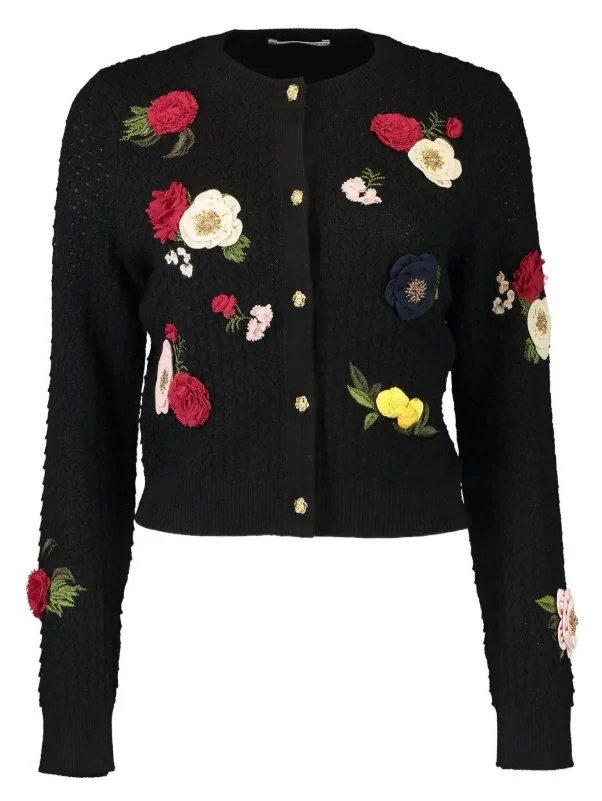
A machine-knitted cardigan can become a distinctive designer garment through the addition of carefully developed handmade details. This floral cardigan demonstrates how three-dimensional hand-crocheted flowers, embroidery, decorative beads and textured knitting can be brought together within one garment.
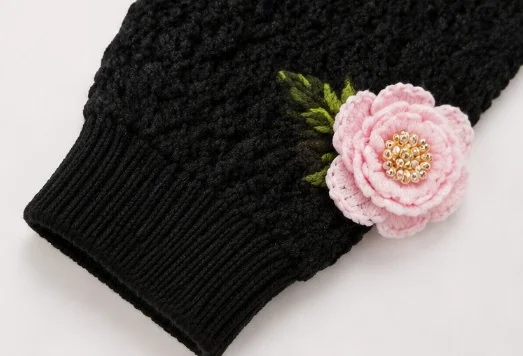
The design features a black knitted body decorated with flowers in red, yellow, turquoise, beige, white and pink. Each flower is individually crocheted to create a raised, layered appearance rather than a flat printed effect. Green handmade leaves, embroidered details, decorative beads and gold-tone floral buttons add further dimension.
The challenge in developing this type of knitwear is not simply producing attractive individual flowers. It is coordinating handmade components with the knitted fabric, maintaining consistent flower dimensions and placement, and establishing construction standards that can be followed throughout production.
At VIAKNIT, we approach this as a combined knitwear and embellishment development project. The knitted body, crochet flowers, decorative components and attachment methods need to be considered together from the beginning.
Project Background
This women's floral cardigan represents a distinctive direction in designer knitwear, where a relatively structured knitted garment becomes a statement piece through handmade decorative elements.
The black knitted body provides a visual background for the colourful floral arrangement. Red, yellow, turquoise, beige, white and pink flowers create contrast, while their layered crochet construction gives the garment a dimensional surface.
Unlike printed floral designs, these flowers are individually constructed textile components. They have their own shapes, thicknesses, layers and decorative details before being attached to the garment.
For independent fashion labels, this approach offers considerable creative flexibility. Flower shapes, colours, sizes and arrangements can be developed to suit a brand's visual identity and seasonal collection.
From a manufacturing perspective, however, handmade embellishment introduces additional variables. Different crochet workers may produce slightly different loop tension, petal shapes and flower dimensions. The attachment method must also be suitable for the knitted fabric.
The key development objective is to bring these individual handmade elements together into a coordinated garment construction.
Garment Design and Construction Requirements
The cardigan can be divided into four main development areas.
| Development Area | Key Design Requirements |
|---|---|
| Main Knitted Fabric | Black knitted body with textured and open-stitch details |
| Hand-Crocheted Flowers | Multiple colours, layered petals, different sizes and dimensional shapes |
| Decorative Embellishment | Green handmade leaves, embroidery, centre beads and gold-tone floral buttons |
| Garment Construction | Round neckline, front opening, button fastening, cuffs and hem ribbing |
The knitted body and handmade flowers require different technical considerations.
For the main fabric, yarn composition, yarn count, target garment weight and desired surface texture need to be established before selecting the appropriate knitting gauge and stitch construction.
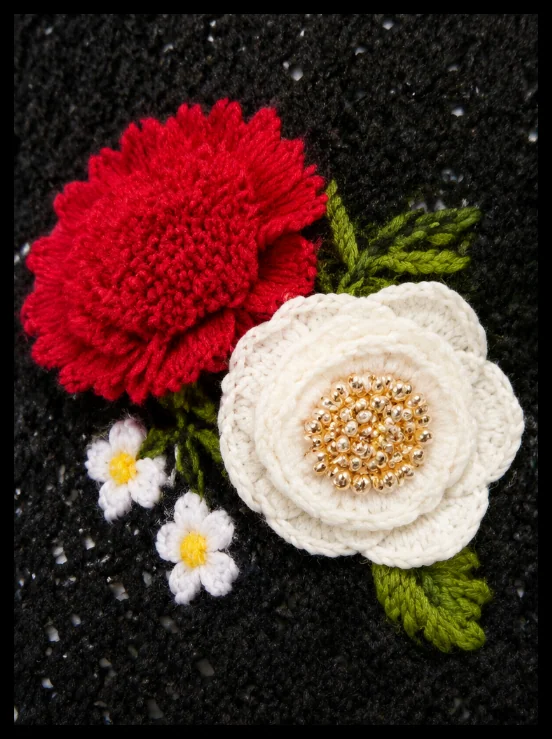
For the flowers, the development team needs to establish a separate crochet reference for each design. This should include the yarn, finished diameter, number of petals, number of layers, thickness and centre decoration.
A Crochet Swatch Board can be used to compare the different flower designs and provide a consistent reference for subsequent sampling.
This is particularly important when several flower colours and sizes appear on the same garment. The flowers should look like part of one coordinated collection rather than unrelated handmade accessories.
Six Technical Challenges in Floral Knitwear Development
3.1 Maintaining Consistent Dimensions in Hand-Crocheted Flowers
Hand crochet involves manual control of yarn tension, loop formation and stitch placement. Even when following the same design, differences in working tension can affect the final dimensions and shape of individual flowers.
For a cardigan with multiple decorative flowers, inconsistent dimensions can change the visual balance of the entire garment.
The development approach is to establish a reference flower for each design before proceeding with the full arrangement.
The main specifications should include finished diameter, petal count, crochet layers, yarn thickness and the shape of the flower centre.
These references allow the crochet work to be organised around consistent construction requirements rather than relying entirely on individual workmanship.
3.2 Attaching Crochet Flowers Without Distorting the Knitted Fabric
One of the most important considerations is the relationship between the weight of the flowers and the structure of the knitted body.
If a flower is too heavy for the supporting fabric, it may pull the knitted stitches downwards and create local distortion. If the attachment is too tight, the fabric may lose its natural flexibility around the decorative area.
The attachment method therefore needs to be considered in relation to the actual knitted structure.
During development, different attachment approaches can be evaluated on representative fabric swatches. Particular attention should be given to the flower edges, centre and main stress points.
The objective is to achieve secure attachment without creating visible puckering or unnecessary tension in the surrounding fabric.
3.3 Coordinating Different Flower Colours and Crochet Textures
The cardigan combines strong colours such as red, yellow and turquoise with softer shades including beige, white and pink.
Colour coordination is only one part of the process. Yarn thickness, surface appearance and crochet density also influence how the flowers look together.
If the yarns have significantly different visual textures or the crochet tension varies between colours, the flowers may appear inconsistent even when their colours are correct.
The development team therefore needs to consider the yarn and crochet construction together.
A consistent reference for yarn thickness, flower dimensions, layer construction and surface appearance helps maintain a coordinated decorative effect across the garment.
3.4 Securing Beads and Decorative Buttons
Beads and decorative buttons provide important visual details, but they also introduce additional attachment and durability requirements.
The centre beads and gold-tone floral buttons should be evaluated in terms of their size, weight, attachment points and compatibility with the garment.
The attachment thread and stitching method need to provide adequate security without damaging or excessively tightening the knitted fabric.
Pull testing and repeated-use checks should be considered for these components as part of the relevant product quality assessment.
Sharp edges, loose beads and insecure buttons also need to be considered, particularly for garments intended for regular wear.
A decorative component should be assessed for both appearance and practical use.
3.5 Combining Open-Stitch Knitting with Three-Dimensional Embellishment
The main knitted fabric includes open-stitch and textured areas, which create a different support structure from a dense, plain knitted surface.
If flowers are attached to an area with insufficient structural support, the surrounding stitches may stretch or the openings may become distorted.
Flower placement should therefore be considered alongside the knitted construction.
Areas around the shoulders, chest and sleeves deserve particular attention because they experience movement during normal wear.
The attachment points should be selected with the fabric structure and intended garment use in mind.
This is why the main knitted body and the decorative elements should not be developed as completely separate products. Their interaction is an important part of the overall construction.
3.6 Standardising Handmade Details for Repeatable Production
A handmade sample can be individually adjusted by an experienced worker. However, repeating the same design across multiple garments requires clearer production references.
Without defined flower specifications, different workers may produce variations in size, petal count, layer thickness and colour arrangement.
The same applies to flower placement and attachment methods.
For this type of product, production documentation should include approved flower samples, yarn and colour references, placement specifications, attachment methods and inspection requirements.
Larger flowers, smaller flowers, double-layer flowers and flowers with centre beads should be assigned separate construction references.
This makes it easier to organise production tasks, maintain visual consistency and calculate the materials and labour required for different decorative components.
VIAKNIT's Development Approach
We recommend a five-stage development process for this type of floral knitwear.
Stage 1 — Main Fabric Development
The first stage focuses on the knitted body.
Yarn composition, yarn count, target garment weight and the desired fabric hand feel are reviewed before selecting the knitting structure and gauge.
Representative fabric swatches can then be used to assess texture, density, breathability and the appearance of the black base fabric.
Stage 2 — Crochet Flower Development
Each flower design is developed as an individual textile component.
The crochet yarn, flower diameter, petal count, number of layers and centre decoration are defined through sample development.
A Crochet Swatch Board provides a practical reference for comparing the different colours and flower constructions.
Stage 3 — Flower Placement and Layout Approval
Once the flower samples are available, their arrangement on the garment can be reviewed.
The flowers are positioned across the body and sleeves to establish the intended visual balance.
A placement reference or garment layout image can be prepared for review before the complete sample is finalised.
Stage 4 — Complete Garment Sampling
The knitted body and handmade components are brought together in the complete cardigan.
This stage includes the knitted construction, crochet flowers, green leaves, embroidery, beads, front opening, decorative buttons and ribbed finishing.
The review should consider not only the appearance of each component but also how the embellishments interact with the garment during wear.
Stage 5 — Revision and Production Approval
The complete sample is reviewed for garment proportions, flower dimensions, placement, attachment security and overall appearance.
Any required adjustments should be recorded in the relevant technical specifications.
Before bulk production, the approved flower references, yarn and colour standards, placement instructions and attachment requirements should be made available to the production team.
VIAKNIT's Technical Decisions
For this type of product, we recommend treating the main knitted garment and the handmade floral embellishments as two coordinated development workstreams.
Main Knit Construction
The main body should be developed according to the designer's requirements for texture, fabric weight, flexibility and wearing comfort.
The neckline, front opening, cuffs and hem also require attention to rib construction, elasticity and dimensional stability.
Crochet Flower Specifications
Each flower design should have its own Crochet Flower Specification.
The specification should identify the yarn, colour, petal count, number of layers, finished diameter and centre decoration.
This is particularly useful when the garment contains flowers with different shapes and dimensions.
Attachment Construction
The flower attachment method should be selected according to the structure and density of the knitted fabric.
The stitching needs to provide sufficient security while allowing the surrounding fabric to move naturally.
Decorative Component Approval
Gold-tone buttons, beads and other decorative components should be standardised through a Trim Approval Card.
Their specifications, colours and suppliers should be confirmed before production begins.
Production Classification
Not all flowers should be treated as identical components.
Large flowers, small flowers, double-layer flowers and flowers with bead decoration may require separate construction codes.
This approach helps organise handmade production, material consumption and labour allocation more clearly.
Quality Control: From Handmade Components to Finished Garment
Quality assessment for floral knitwear needs to cover both the main knitted fabric and the handmade embellishments.
| Inspection Area | Main Quality Requirements |
|---|---|
| Flower Dimensions | Consistent with the approved reference |
| Flower Placement | Correct horizontal and vertical positioning |
| Petal Construction | No obvious missing layers, loose stitches or deformation |
| Attachment Security | No loose components or visible fabric distortion |
| Beads and Buttons | Secure attachment, no loose parts or sharp edges |
| Main Knitted Fabric | No dropped stitches, holes or obvious colour differences |
| Garment Measurements | Within the approved measurement specifications after washing |
| Overall Appearance | Consistent flower distribution and visual proportions |
For garments made with wool or other natural fibres, dimensional stability, pilling and surface changes should also be considered according to the final care requirements.
It is important to distinguish between two separate quality considerations.
The attachment security of handmade embellishments is not the same as the dimensional stability of the knitted fabric after washing.
A garment wash assessment alone cannot establish that every decorative component will remain secure throughout long-term use.
The relevant inspection and testing requirements should therefore be defined separately according to the garment specification and customer requirements.
What Designers Should Consider Before Developing Floral Knitwear
Three-dimensional floral knitwear requires more planning than a conventional printed or embroidered garment.
The flower designs need to be considered as individual components, while their placement and weight must be compatible with the main knitted fabric.
Before starting development, designers should ideally provide reference images, preferred flower colours, approximate dimensions, garment measurements and the intended arrangement of decorative elements.
If a complete Tech Pack is not available, the project can begin with a design review and technical discussion to identify the main construction requirements.
For more complex designs, it is worth confirming the flower samples before completing the full garment. Flower size, thickness and layering can significantly affect the overall visual proportions.
Early confirmation also reduces the risk of having to revise the entire garment because of changes to the decorative components.
Technical Questions
How are 3D crochet flowers developed for knitwear?
The development begins with the flower design, yarn selection and desired three-dimensional effect.
The flower is then developed through crochet sampling, with attention to its diameter, petal count, number of layers, thickness and centre decoration.
Approved flower samples can be used as references for subsequent production.
How do you secure crochet flowers to a knitted cardigan?
The attachment method should be selected according to the flower's weight and the structure of the supporting knitted fabric.
The attachment points need to provide adequate security without pulling the surrounding stitches or creating visible puckering.
Testing the attachment on a representative knitted fabric swatch helps evaluate the construction before full garment sampling.
How do 3D floral embellishments affect garment weight and drape?
Three-dimensional flowers add material and weight to the garment, and their distribution can influence how the knitted fabric hangs.
Large or densely arranged flowers may create more localised weight, potentially affecting the garment's drape and the surrounding fabric.
The flower dimensions, yarn choice, placement and attachment method should therefore be considered together during development.
Related Expertise
Three-Colour Argyle Cardigan with Mohair Hand Embroidery ↗
Discuss Your Project