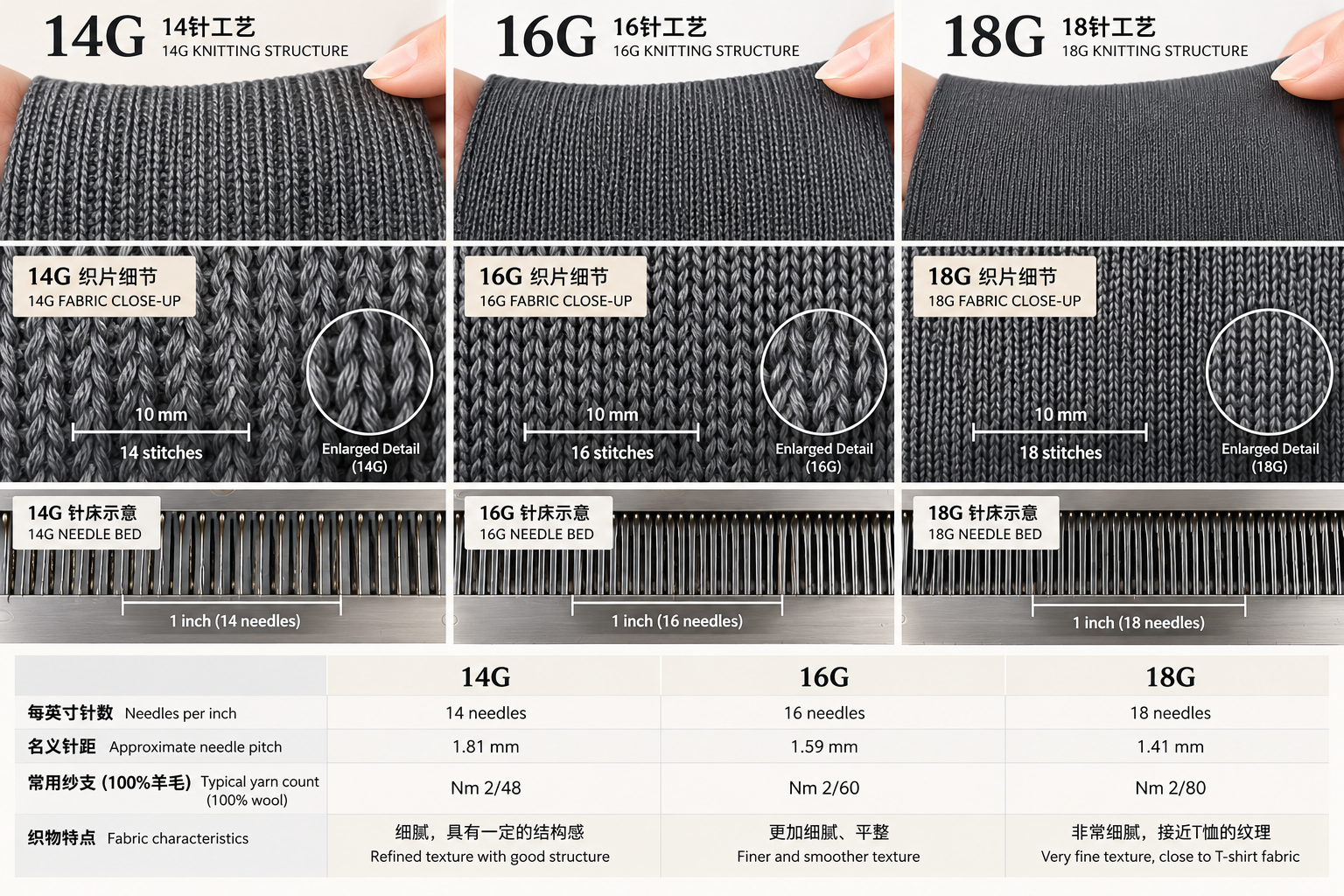
Choosing between 14G, 16G and 18G is an important decision when developing fine-gauge knitwear.
For fashion designers, the choice affects more than stitch appearance. It can influence fabric weight, handle, construction, manufacturing complexity and production cost.
The key difference between 14G, 16G and 18G is needle density. In conventional flat knitting, gauge generally refers to the number of needles per inch on the needle bed. Higher gauge numbers mean closer needle spacing, allowing finer knitted structures.
However, a higher gauge does not automatically mean a softer, lighter or better-quality garment.
At VIA KNIT, a knitwear development and manufacturing company based in Dongguan, China, we have practical experience developing and producing 14G, 16G and 18G garments for European and American clients.
This guide explains how the three gauges differ, how yarn counts affect development decisions, and what designers can learn from real fine-gauge manufacturing projects.
What Is the Difference Between 14G, 16G and 18G?
Machine gauge indicates needle density.
| Gauge | Needles per Inch | Approximate Needle Pitch |
|---|---|---|
| 14G | 14 | 1.81 mm |
| 16G | 16 | 1.59 mm |
| 18G | 18 | 1.41 mm |
The needle-pitch figures are nominal calculations based on 25.4 mm per inch. They do not represent the actual dimensions of the knitted loops.
As the gauge number increases, the needles are arranged more closely together.
This generally allows finer stitch formation, although the resulting fabric also depends on yarn construction, stitch density and machine settings.
Technical Takeaway
The best knitting gauge is not necessarily the highest gauge. It is the gauge that allows the intended yarn and stitch structure to achieve the desired fabric characteristics.
Comparing 14G, 16G and 18G Knitwear
All three gauges can be used in fine-gauge garment development.
| Consideration | 14G | 16G | 18G |
|---|---|---|---|
| Needle arrangement | Fine | Finer | Very fine |
| Typical development | Lightweight sweaters and knitted tops | Fine-knit tops and close-fitting layers | Very fine-knit tops and lightweight layers |
| Fabric appearance | Refined stitch definition | More delicate stitch definition | Very fine stitch definition |
| Yarn requirements | Fine yarn configurations | Often finer configurations | Often very fine configurations |
| Development challenges | Fabric structure and handle | Fine construction and production cost | Delicate handling, linking and finishing |
These are general development tendencies, not fixed limitations.
A 14G garment can be lightweight, while an 18G garment can be suitable for autumn or winter layering.
Seasonal suitability depends on the completed fabric rather than the machine gauge alone.
Which Yarn Counts Are Suitable for Fine-Gauge Knitwear?
Yarn selection and knitting gauge must be considered together.
VIA KNIT has practical development experience with metric yarn counts including:
Nm 2/48, Nm 2/60, Nm 2/80, Nm 2/100 and Nm 2/120.
Among these, Nm 2/48 and Nm 2/60 are frequently used in our development work.
For 100% wool, the following combinations can provide useful starting references:
| Machine Gauge | Illustrative Yarn Count | Material |
|---|---|---|
| 14G | Nm 2/48 | 100% wool |
| 16G | Nm 2/60 | 100% wool |
| 18G | Nm 2/80 | 100% wool |
These are examples drawn from manufacturing experience, not universal yarn-count requirements.
A given gauge may accommodate different yarn specifications depending on fibre characteristics, ply, twist, stitch construction and target fabric density.
Even two yarns labelled 100% wool can produce different results because of differences in fibre fineness, spinning and yarn construction.
For this reason, yarn and gauge selection should be confirmed through physical swatch development.
How Do 14G, 16G and 18G Affect Garment Development?
14G: Fine Texture and Structural Balance
14G is used for lightweight knitted tops, fine-gauge sweaters and selected base-layer garments.
Depending on yarn and construction, it can provide refined stitch definition while retaining suitable fabric structure.
It can be used for lightweight plain-knit fabrics as well as more structured constructions.
16G: Refined Texture and Lightweight Development
16G offers closer needle spacing than 14G.
It can be considered for garments requiring fine stitch definition, lightweight fabric development and a refined surface.
In certain projects, changing from 14G to 16G can help achieve a lighter or more comfortable fabric.
However, such results must be verified through actual swatches; they cannot be assumed from gauge alone.
18G: Very Fine-Knit Construction
18G is relevant to very fine-gauge garments, including lightweight knitted tops, fine-knit T-shirt styles and selected close-fitting base layers.
Its finer needle arrangement supports delicate knitted structures.
However, successful 18G production requires careful attention to yarn compatibility, panel handling, linking, seaming and finishing.
The manufacturing process is therefore an important part of evaluating whether 18G is appropriate for a project.
Why Does Fabric Handle Vary Even with the Same Gauge?
Two garments produced on the same gauge may have different weights, textures and wearing characteristics.
The differences can arise from several factors:
Fibre fineness and composition; Yarn count, ply and twist; Knitted stitch construction; Stitch density and machine settings; Washing, pressing and finishing.
For example, two 16G wool fabrics may have different levels of softness and drape even when both use 100% wool.
This is why physical fabric evaluation remains important during fine-gauge product development.
Rather than selecting a gauge in isolation, designers should begin with the desired garment characteristics.
Why Can 50-Piece Orders Be More Expensive for 16G and 18G?
VIA KNIT's standard minimum order quantity starts at 50 pieces per style for 14G, 16G and 18G knitwear.
However, the minimum acceptable quantity is not always the most cost-efficient production quantity.
For some 16G and 18G garments, smaller production runs involve additional technical complexity, careful handling and material loss.
These requirements can result in substantially higher unit processing costs for a 50-piece order compared with a similar 100-piece order.
For this reason, VIA KNIT generally recommends considering 100 pieces per style for 16G and 18G projects when the collection plan and budget allow.
A 50-piece order remains possible under the standard MOQ conditions.
Actual pricing depends on the yarn, garment construction, processing requirements and production quantity.
Manufacturing Takeaway
MOQ and cost-efficient order quantity are not necessarily the same. Designers should evaluate both before finalising a fine-gauge collection.
What Makes 18G Knitwear More Challenging to Manufacture?
Very fine-gauge knitwear requires careful coordination across multiple manufacturing stages.
Based on VIA KNIT's experience, 18G development can involve challenges related to snagging, fabric stability, surface appearance, linking and seaming.
Protecting Delicate Knitted Panels
Fine knitted panels can be vulnerable to snagging and yarn pulling during handling.
At VIA KNIT, protective bags are used to reduce unnecessary contact, and workers wear gloves when handling delicate panels.
Panels are also inspected before subsequent finishing operations.
Managing Dimensional Behaviour
Dimensional stability is considered during pre-production sampling.
The fabric must be assessed in relation to the intended garment specifications and finishing requirements.
Pressing is incorporated at appropriate stages of production.
However, pressing alone does not establish dimensional stability. Actual fabric and garment measurements remain necessary to assess the result.
Managing Surface Appearance
Delicate fabrics may develop localised marks or surface distortion during handling and finishing.
VIA KNIT uses pressing at designated production stages, including before seaming, before washing and after water extraction, according to the garment's requirements.
The specific approach depends on the fabric construction and finishing process.
Fine-Gauge Linking and Seaming
Linking and seaming can become particularly demanding when working with very fine knitted structures.
VIA KNIT assigns workers according to the technical requirements of different operations.
Sleeve attachment, side seaming and neckline construction are organised with attention to the skills required for each task.
Neckline operations, in particular, may be assigned to more experienced workers because of their importance to the garment's appearance.
These practices illustrate an important principle:
Fine-gauge manufacturing capability depends on skilled production management as well as knitting equipment.
Development Case Study: A US Brand's 16G-to-14G Adjustment
A US client initially requested a specific stitch construction on a 16G machine.
However, the proposed construction involved relatively high manufacturing costs.
After discussing the intended fabric appearance and structural requirements, an alternative 14G construction was evaluated.
The revised approach achieved a similarly firm and even fabric appearance while providing a more suitable manufacturing option for the project.
The example demonstrates how gauge selection and stitch engineering can work together.
A designer may begin with a particular machine specification, but an alternative construction can sometimes achieve a comparable result.
The suitability of any substitution must be confirmed through actual fabric development.
This anonymised account describes the development decision without disclosing the client's identity or proprietary design.
Development Case Study: A Nordic Brand's 14G-to-16G Adjustment
A Nordic client initially considered 14G for a fine-knit base-layer garment.
During development, a 16G alternative was found to produce a lighter fabric with a softer, more comfortable feel against the skin.
The client subsequently selected the 16G approach.
This example highlights why designers should remain open to evaluating alternative gauges during sampling.
For garments worn close to the body, weight, softness and wearing comfort may be more important than retaining the initially proposed machine gauge.
Development Takeaway
A successful gauge decision should be guided by the intended fabric performance and wearing experience, rather than the initial technical specification alone.
How Should Designers Choose Between 14G, 16G and 18G?
Before choosing a machine gauge, it is useful to clarify five requirements.
Product Type
Is the garment a knitted T-shirt, polo, lightweight sweater or base layer?
Desired Fabric Characteristics
Should the fabric feel lightweight, soft, structured, smooth or fluid?
Material Selection
Which fibre composition and yarn characteristics are required?
Stitch Construction
Will the design use plain knit, rib or a more complex structure?
Production Quantity and Budget
Is the project planned around 50 or 100 pieces per style, and how important is unit processing cost?
These considerations help determine which gauge and yarn combinations should be explored.
Where appropriate, physical swatches can be developed to compare alternative technical approaches.
What Should Brands Look for in a Fine-Gauge Knitwear Manufacturer?
When selecting a manufacturing partner, brands should look beyond a list of available machine gauges.
Important considerations include:
Practical experience with the requested gauge; Previous garment development and bulk production; Ability to evaluate yarn and stitch combinations; Knowledge of fine-gauge manufacturing challenges; Skilled linking, seaming and finishing; Ability to discuss alternative development solutions.
VIA KNIT has experience developing and manufacturing 14G, 16G and 18G knitwear for European and American clients.
Our manufacturing resources combine primarily in-house production capabilities with established equipment partnerships.
Our development experience includes STOLL, SHIMA SEIKI and CIXING equipment. SHIMA SEIKI equipment is commonly used in our 14G and 16G projects, while CIXING equipment is primarily used for 18G development.
Our focus is on helping brands evaluate yarn selection, gauge, stitch construction, fabric characteristics and production feasibility together.
Specific manufacturing requirements are assessed according to each project.
Conclusion: Choose the Right Gauge, Not Simply the Highest Gauge
14G, 16G and 18G can all support premium fine-gauge knitwear development.
Higher gauge numbers generally indicate closer needle spacing, but the finished garment depends on much more than gauge alone.
Yarn selection, stitch engineering, fabric testing, skilled workmanship and finishing all contribute to the final result.
For fashion designers, the objective should be to choose a technical approach that supports the intended design and production requirements.
The right gauge is not simply the finest gauge. It is the gauge that best supports the intended fabric and garment.
Developing a Fine-Gauge Knitwear Collection?
VIA KNIT works with independent designers and international fashion brands on small-batch knitwear development and manufacturing.
If you are developing 14G, 16G or 18G knitwear, share your design references, preferred materials, target fabric characteristics and estimated order quantities with our team.
About the Comparison Illustration
The comparison image is an AI-generated illustration, not a photograph of VIA KNIT equipment, workshop swatches or client products. Its needle-bed depictions, fabric proportions, yarn illustrations and embedded scale or stitch-count labels are not measured evidence and must not be used for dimensional or stitch-density comparisons. Refer to the qualified explanations and tables above, and confirm specifications through physical swatch development.