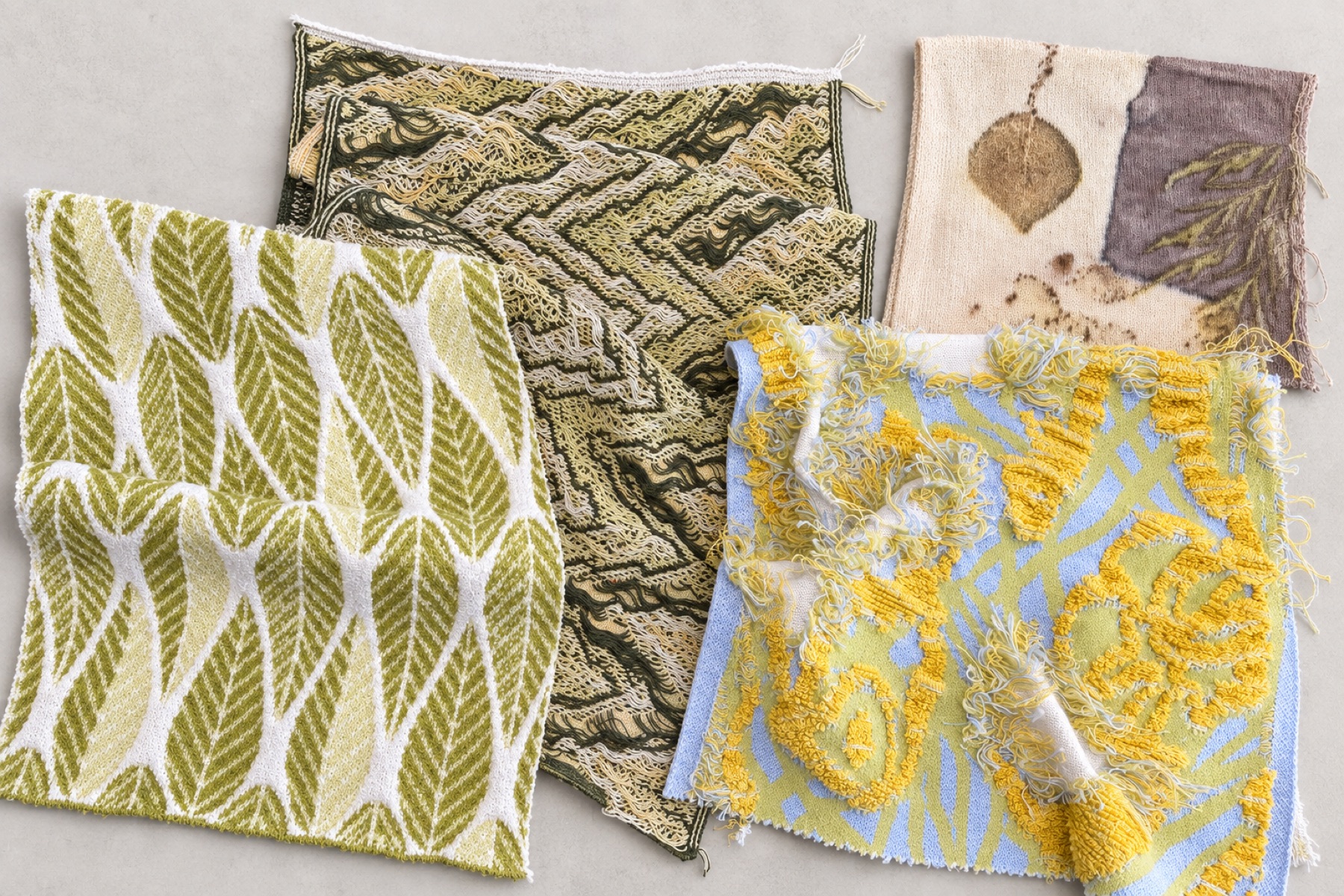
At VIA KNIT, MOQ is calculated as the total number of pieces per style. The standard 50-piece arrangement is one colour across three sizes. Confirmed 100-piece arrangements include three colours and three sizes, two colours and three sizes, or two colours and four sizes. Other colour–size combinations are not automatically permitted.
Why does a 100-piece knitwear order work with certain colour and size combinations, but require adjustments for others?
For independent fashion brands preparing a new collection, minimum order quantity (MOQ) is often one of the first considerations when choosing a knitwear manufacturer.
However, in knitwear manufacturing, MOQ is about more than the total number of garments.
It also depends on the number of styles, colours, sizes, yarn availability and production requirements.
Understanding these factors is especially important for emerging designer brands looking to develop premium knitwear in smaller quantities without compromising their design direction.
Based in Dongguan, China, VIA KNIT specialises in small-batch knitwear manufacturing, fine-gauge knitting, premium yarn sourcing and complex knitwear product development.
We work with international fashion brands to evaluate not only the total order quantity, but also how colours, sizes and materials can be organised into a practical production plan.
In this guide, we explain how knitwear MOQ works, share our standard order arrangements and illustrate how thoughtful planning can help brands develop small knitwear collections.
What Does MOQ Mean in Knitwear Manufacturing?
MOQ stands for Minimum Order Quantity — the minimum quantity a manufacturer accepts under specified production conditions.
Depending on the manufacturer, MOQ may be calculated:
Per style Per colour Per size Per style and colour combination
These distinctions matter.
When a manufacturer advertises a minimum order quantity of 50 pieces, it is important to clarify whether that means 50 pieces per style or 50 pieces per colour.
At VIA KNIT, our standard MOQ is calculated by total pieces per style.
Per style is different from per colour
For example, a 50-piece order refers to the total production quantity of one knitwear style, rather than 50 pieces for each individual size.
However, the number of colours and sizes must still follow the applicable order structure.
A 50-piece MOQ does not mean that any combination of colours and sizes is possible.
This is an important consideration when planning a small-batch knitwear collection.
Understanding VIA KNIT's Small-Batch MOQ Structure
VIA KNIT supports independent designers and fashion brands developing premium knitwear in smaller production quantities.
Our standard MOQ arrangements include:
| Total quantity per style | Colours | Sizes | Standard arrangement |
|---|---|---|---|
| 50 pieces | 1 | 3 | Standard arrangement |
| 50 pieces | 2 | — | Not a standard combination |
| 50 pieces | — | 4 | Not a standard combination |
| 100 pieces | 3 | 3 | Acceptable |
| 100 pieces | 2 | 3 | Acceptable |
| 100 pieces | 2 | 4 | Acceptable |
| 100 pieces | 4 | 4 | Not a standard combination |
These are the confirmed combinations, not a rule from which every other combination can be inferred. Other arrangements require confirmation. A dash means that the other dimension was not specified for that excluded combination; it does not define another accepted arrangement.
The quantity is the total per style, not a separate minimum for each colour or size. The allocation of pieces across the agreed colours and sizes is confirmed for the order.
For example, a fashion brand developing a fine-gauge wool sweater may begin with 50 pieces in one colour across three sizes.
If the brand wishes to introduce additional colours or sizes, the total production quantity may need to increase.
For a 100-piece order, more flexibility is available.
A brand may choose three colours across three sizes, or two colours across four sizes, depending on its collection requirements.
These arrangements help establish a workable product structure before production begins.
They also allow manufacturers and designers to identify potential limitations during the development stage rather than after production planning has been finalised.
Please note: These are VIA KNIT's standard quantity arrangements. Special yarns, complex constructions, embellishments and other development requirements may require individual assessment.
Why Do Colours and Sizes Affect Knitwear MOQ?
Consider two fashion brands planning to manufacture 100 sweaters each.
Brand A proposes:
3 colours × 3 sizes
Brand B proposes:
4 colours × 4 sizes
Although both brands are ordering the same total number of garments, the complexity of their production arrangements is different.
Colour Options Affect Yarn Planning
Each additional colour may require separate yarn sourcing, stock verification or custom dyeing.
When the total order quantity remains unchanged, increasing the number of colours generally reduces the average quantity produced in each colour.
For smaller production runs, this can make material purchasing and production planning more complicated.
Size Options Affect Production Specifications
Different sizes require corresponding measurements, technical specifications and quality checks.
Increasing the number of sizes introduces more variations to manage during production.
For fine-gauge knitwear, complex constructions or embellished garments, these variations should be considered early in development.
Colour and Size Decisions Work Together
A practical MOQ discussion should therefore consider two questions:
How many garments will be produced?
And equally importantly:
How many colours and sizes will be included within that quantity?
Small-batch manufacturing is not simply about producing fewer garments.
It is about creating an appropriate balance between order quantity, design requirements and production conditions.
Stock Yarns vs Custom-Dyed Colours
Yarn selection is another important consideration when planning a small knitwear collection.
Beyond influencing appearance, texture and product performance, yarn availability can also affect production lead times.
At VIA KNIT, we help brands explore suitable yarn options according to their design and development requirements.
Stock Yarns
Suitable stock yarns can be assessed first. Actual availability must be checked for the proposed project.
For independent fashion brands, choosing suitable stock yarns can simplify material sourcing and reduce the waiting time associated with custom dyeing.
However, actual availability must always be confirmed according to the required fibre composition, yarn count, colour and dye lot.
Custom-Dyed Yarns
Some brands require exclusive colours to match their collection concepts or established brand palettes.
In these situations, custom yarn dyeing may be necessary.
Based on VIA KNIT's current sourcing experience:
Custom yarn dyeing typically takes approximately 15–20 days. Compared with a suitable stock-yarn option, the overall bulk production lead time generally increases by approximately 15–20 days as well.
The overall increase describes the usual effect of the dyeing stage, not a second 15–20-day allowance to add on top of it. These timings reflect general experience, not an unconditional guarantee. Actual timing depends on the yarn supplier, fibre type, colour approval and production arrangements.
For brands working towards a specific collection launch date, it is therefore advisable to consider custom colour requirements early in the development process.
Choosing stock colours where appropriate can offer greater flexibility during production planning.
The objective is not to compromise the designer's creative direction, but to understand how different material decisions affect the overall development schedule.
A Real Example: Planning a 100-Piece Order for a Nordic Brand
During a small-batch knitwear development discussion, a Nordic fashion brand initially proposed producing 100 pieces of one style across:
4 colours × 4 sizes
However, this combination exceeded VIA KNIT's standard arrangement for a 100-piece order.
During the discussion, we reviewed how the proposed colour and size options related to the overall production quantity.
The brand subsequently decided to maintain its planned quantity of 100 pieces while adjusting the assortment to:
3 colours × 3 sizes
This revised arrangement aligned with VIA KNIT's standard 100-piece production structure.
The example illustrates an important aspect of small-batch knitwear development:
A workable production plan does not always require increasing the total order quantity. Sometimes, adjusting the colour and size assortment provides a more suitable approach.
For independent designers, reviewing these decisions early can help align collection planning with manufacturing requirements.
Every brand has different customers, sizing needs and commercial priorities. The most appropriate arrangement should therefore be discussed individually.
This example is presented anonymously and excludes client names, actual designs, pricing and confidential project information.
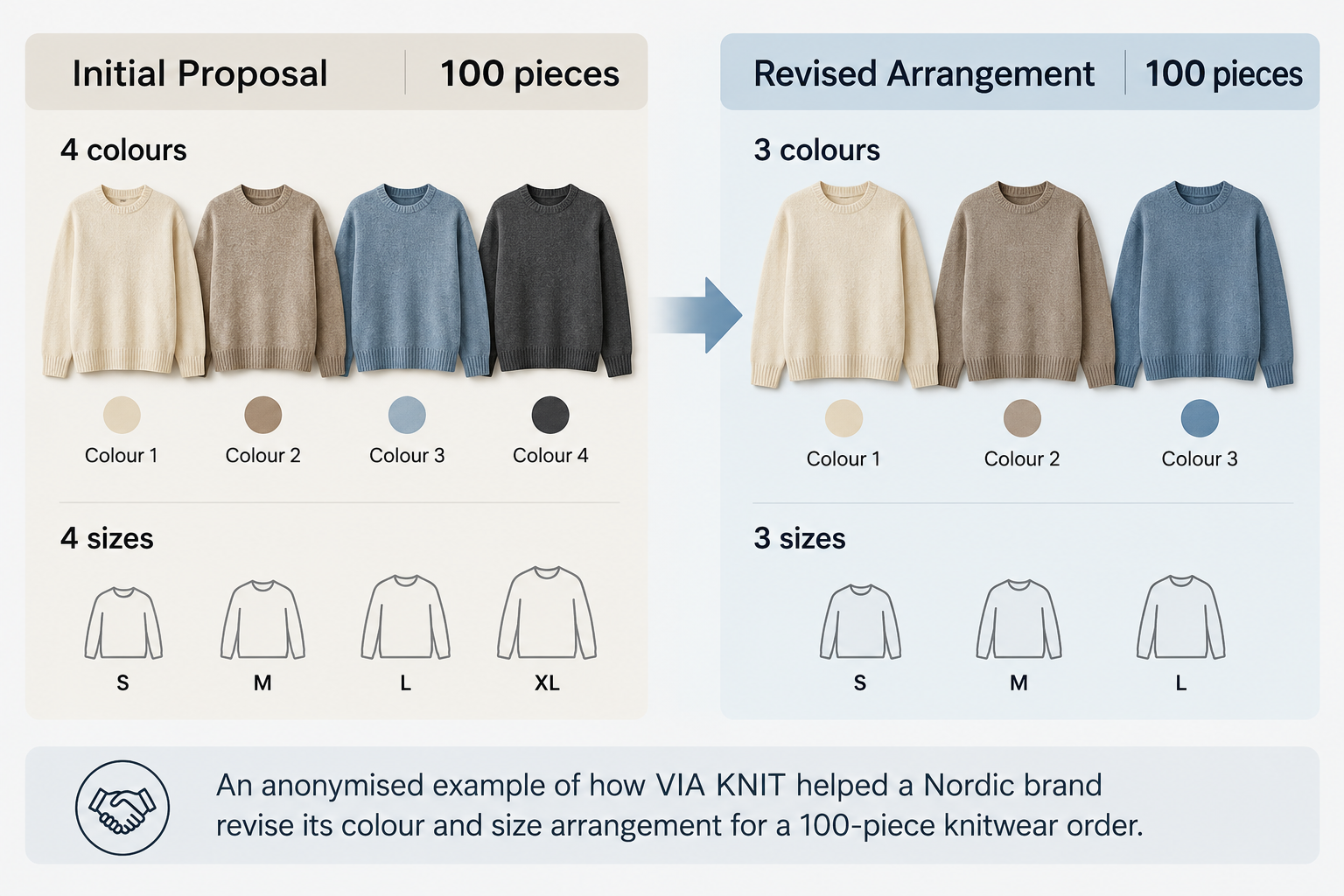
Planning illustration only; not a photograph of the customer's actual product. The garment depictions and size labels are illustrative.
View the planning illustration at full resolution
How Should Independent Brands Plan a Small Knitwear Collection?
Before requesting a manufacturing quotation, designers can prepare five essential pieces of information.
Number of Styles
How many different knitwear styles will be included in the collection?
Do they require different yarns, constructions or manufacturing techniques?
Quantity per Style
What is the intended production quantity for each style?
This should reflect the brand's commercial plans, development budget and expected demand.
Number of Colours
Which colours are essential to the collection?
Are some colours optional, or could they be introduced in a later production run?
Size Range
Which sizes are most relevant to the brand's target customers?
Size planning should support the intended fit and customer requirements rather than simply maximise the number of options.
Yarn and Colour Requirements
Can the collection use suitable stock yarn colours?
Or are exclusive custom-dyed colours necessary?
If custom dyeing is required, additional preparation time should be considered.
Preparing these details allows the manufacturer to evaluate production feasibility and development requirements more accurately.
It also helps both parties identify potential adjustments before sampling and production planning progress too far.
Frequently Asked Questions
Can VIA KNIT manufacture 50 sweaters per style?
Yes. VIA KNIT's standard starting MOQ is 50 pieces per style, arranged in one colour across three sizes, subject to the relevant product and material requirements.
Can I order 50 pieces in two colours?
Not under VIA KNIT's standard 50-piece arrangement. An alternative quantity and colour–size structure must be discussed and confirmed; increasing quantity alone does not establish that an unlisted combination is accepted.
Can I order 50 pieces in four sizes?
Our standard 50-piece arrangement includes three sizes. Fifty pieces across four sizes is not a standard combination. A different quantity and size arrangement needs individual confirmation.
Can I manufacture 100 pieces in three colours and three sizes?
Yes. This is one of VIA KNIT's standard arrangements for a 100-piece order.
Can I manufacture 100 pieces in two colours and four sizes?
Yes. VIA KNIT can accommodate two colours across four sizes within a 100-piece order.
Can I manufacture 100 pieces in two colours and three sizes?
Yes. This is also an available arrangement.
Can I manufacture 100 pieces in four colours and four sizes?
This combination does not meet VIA KNIT's standard arrangement for 100 pieces. The colour and size structure needs to be revised and confirmed. An unlisted higher-quantity combination is not automatically approved.
Does custom yarn dyeing affect production lead times?
Yes. Custom yarn dyeing typically requires approximately 15–20 days. Based on VIA KNIT's current sourcing arrangements, bulk production lead times generally increase by approximately 15–20 days compared with using suitable stock yarns.
These are general experience-based estimates, not unconditional guarantees. Actual timing must be confirmed for the yarn and production requirements.
Can I contact VIA KNIT without a complete tech pack?
Yes. Designers can begin an initial discussion by sharing reference images, expected quantities, colour and size requirements, preferred materials and target delivery dates.
A complete technical package is helpful, but it is not always necessary for an initial development enquiry.
Better Small-Batch Manufacturing Starts with Better Planning
For independent fashion brands, small-batch manufacturing is not only about reducing the initial production quantity.
It is also about aligning product development with realistic material, sizing and manufacturing requirements.
At VIA KNIT, we believe effective knitwear manufacturing begins with understanding both the designer's creative intentions and the practical conditions of production.
By discussing styles, colours, sizes, yarns and order quantities early, brands can make more informed development decisions.
Small batches. Thoughtful development. Better decisions.
Planning a Knitwear Collection?
Whether you are preparing your first knitwear collection or developing a new range for an established brand, VIA KNIT can help you evaluate the practical requirements of your project.
Share your design references, expected quantities, colour and size requirements, and material preferences with our development team.
Explore our knitwear development, materials and manufacturing capabilities, then share the proposed arrangement through Start a Project.