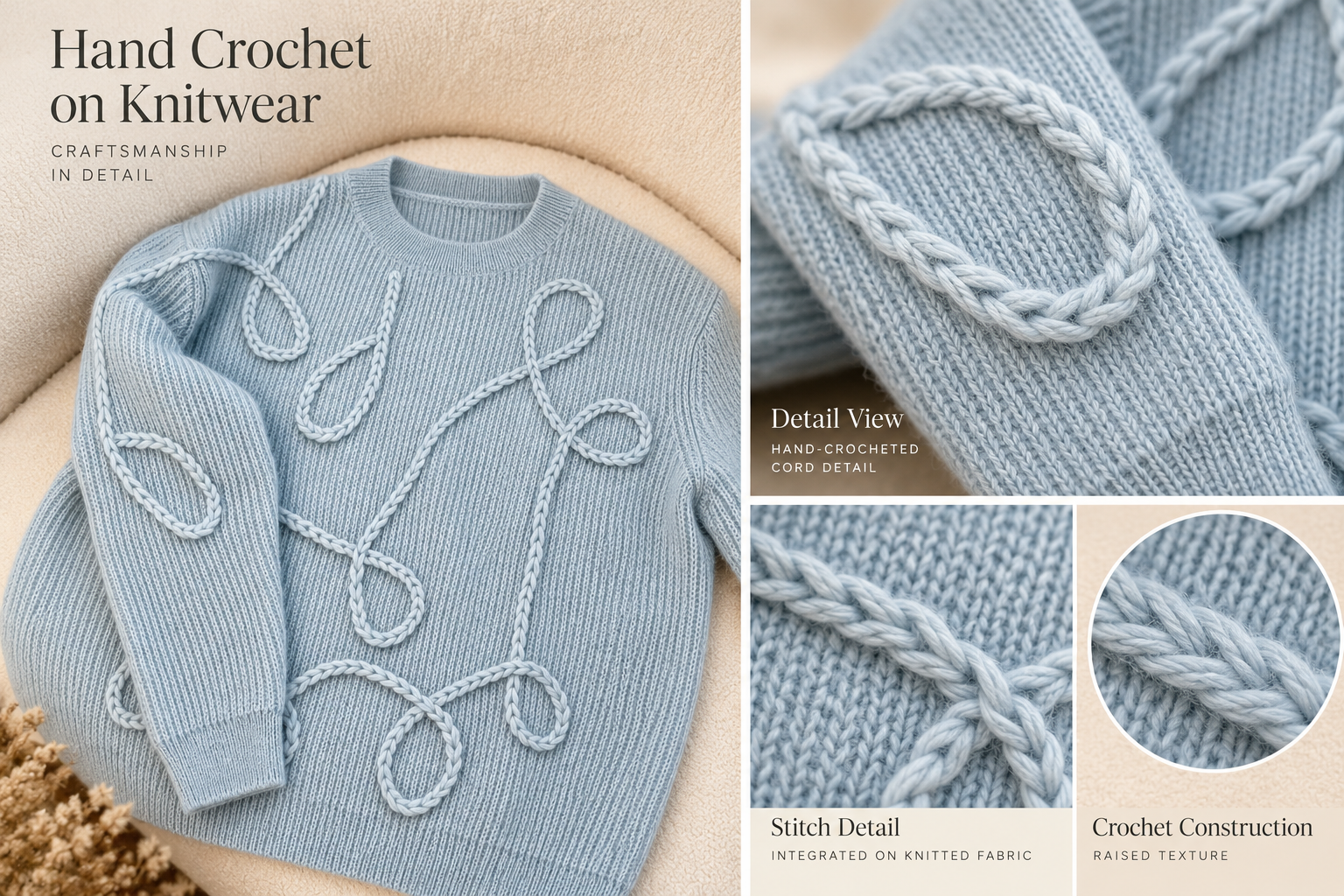
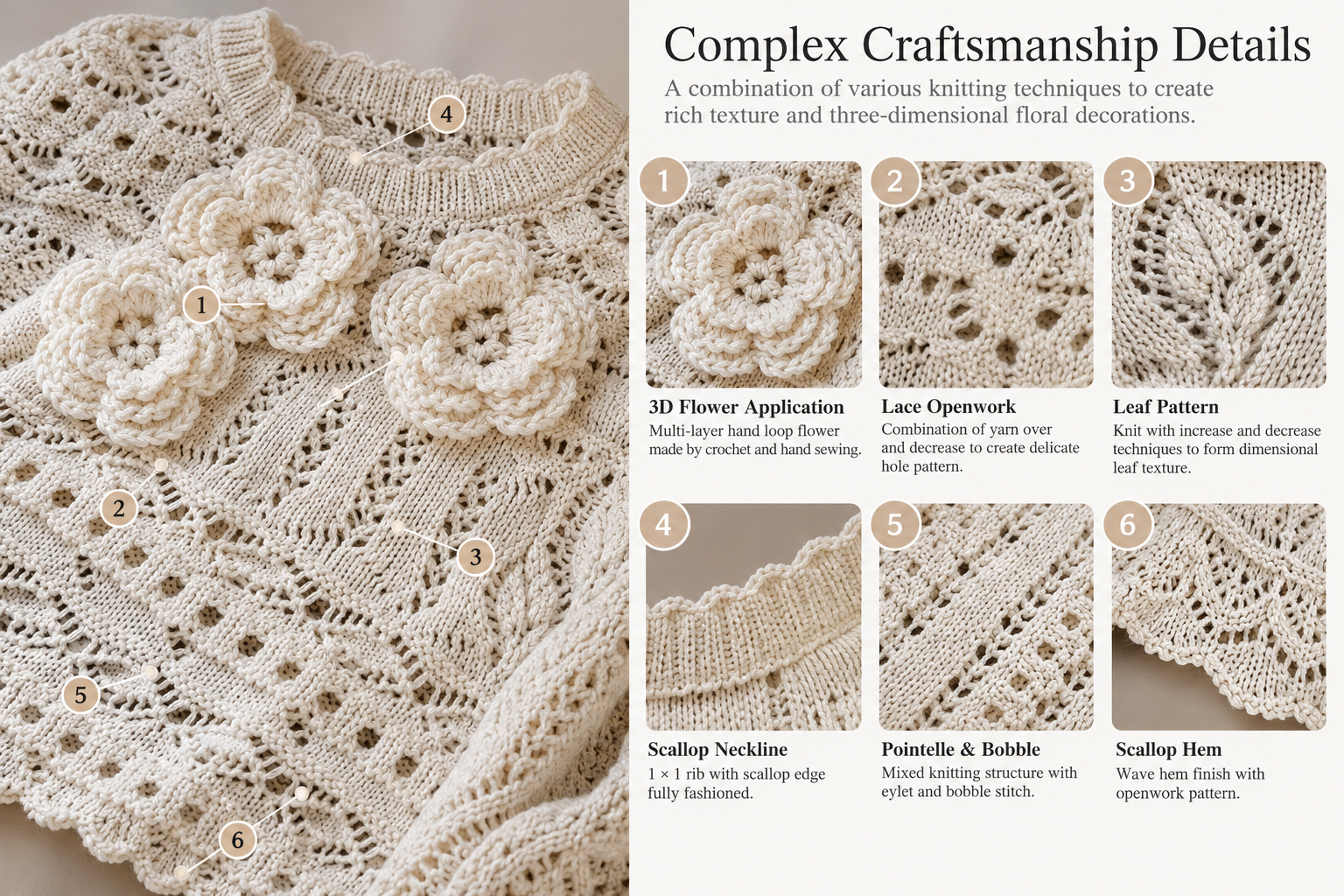
The most difficult part of making a knitted garment does not always happen on the knitting machine. Sometimes, the real challenge begins after the fabric has been knitted. A designer may want to add three-dimensional crochet flowers to a fine-knit cardigan, combine beads and crystals in an elaborate motif, or create a garment that brings silk and knitted fabric together. These details can give a collection its identity. They also introduce questions that need to be resolved before production.
A highly skilled craftsperson may spend several days completing one elaborate sample. Producing 50 or 100 garments with similar details requires a different level of planning. At VIA KNIT, we work with international designer brands on knitwear that involves hand crochet, embroidery, beading, rhinestone applications, printing, special dyeing and combinations of knitted and woven fabrics.
Our role includes technical development, sampling, production coordination and quality follow-up. While sample development involves our internal team, specialist techniques used in bulk production are also carried out through our established network of professional workshops. For complex knitwear, understanding the design is only the beginning. The next challenge is finding a way to make it consistently and within the requirements of the project.
Understanding the Design Before Choosing the Technique
Complex knitwear development often begins with a detail that cannot be fully explained through a technical drawing alone. A designer may want a crochet flower with a particular three-dimensional shape. Another may require an embroidered motif that combines several decorative materials. The intended appearance might be clear, but the actual construction still needs to be established. The size, placement, materials and attachment method can all influence the result.
For this reason, we place considerable importance on understanding the designer's expectations before beginning a complex sample. Physical references and smaller technique samples can be particularly helpful when a visual detail is difficult to describe. The aim is to establish a clear reference for development rather than rely on assumptions about what the designer wants.
Hand Crochet: From a Single Flower to an Entire Garment
Hand crochet is one of the specialist techniques we regularly work with. Projects may involve individual decorative elements, three-dimensional flowers or garments constructed largely through hand crochet. The amount of work can vary significantly. For certain complex designs, a skilled craftsperson may need two to three days to complete the hand-crochet work for one garment. This makes production planning particularly important when a design moves beyond a single prototype.
At VIA KNIT, hand-crochet samples can be developed with our internal team. For bulk production, we also coordinate with established specialist handcraft workshops in the Chaoshan region of Guangdong. The key is to ensure that the approved design can be communicated clearly to everyone involved in production.
Development Story: An American Designer Starts with One Crochet Flower
An American designer once approached VIA KNIT with a reference showing a single hand-crocheted flower. Rather than providing a complete specification for a garment, the designer wanted to explore how the reference could be developed into a finished product. We worked from that initial direction and developed a fully hand-crocheted garment sample. The project subsequently progressed into a 100-piece production order. What made the project interesting was the starting point.
A relatively small design reference became the basis for an entire garment. However, successful sampling did not remove the need for detailed production planning. The handwork requirements and intended appearance still needed to be clearly understood before the larger order could proceed.
Hand Embroidery and Machine Embroidery Serve Different Purposes
Hand embroidery and machine embroidery can both contribute to embellished knitwear, but they are not interchangeable in every situation. Some of the hand-embellishment designs we encounter combine several materials within a single motif. A floral decoration, for example, may incorporate embroidered elements, tubular beads, round beads, flat sequins and crystal details. Each material contributes something different to the overall appearance.
Machine embroidery can be effective for designs that are suitable for its particular construction and production method. The choice between handwork and machine processing therefore depends on more than labour cost alone. The complexity of the motif, its materials and the quantity being produced all need to be considered. At VIA KNIT, we review potential technical and quality issues during sampling.
For bulk production, we coordinate with specialist embroidery workshops and follow the work through the relevant production and inspection stages. The objective is to preserve the approved visual result while using a technique appropriate to the project.
When a Design Combines Beads, Sequins and Crystals
Elaborate surface decoration can be particularly challenging when several materials are combined in one design. A motif may contain tubular beads, round beads, sequins and crystal embellishments. Although these materials form one visual composition, they do not necessarily share the same application method. Their positioning and attachment need to be considered in relation to the knitted fabric.
Development Story: Choosing Hand Embellishment for a 100-Piece US Order
One American client approached us with a complex decorative pattern combining tubular beads, round beads, crystals and sequins. The initial intention was to produce the decoration using machinery. After reviewing the design and the order quantity of 100 pieces, we discussed the technical approach with the client. For this particular combination of materials, we recommended hand application as the more suitable solution for the intended result and quality requirements.
The project illustrates an important point about embellished knitwear. Machine processing is not automatically the best choice for every design. For smaller orders involving several decorative materials, skilled handwork can sometimes offer a more practical way to achieve the desired appearance. The appropriate choice still depends on the individual motif, its construction and the actual production conditions.
Why Dense Rhinestone Applications Can Be Difficult
Rhinestone embellishment has become an important detail in some of the knitwear projects we develop. Designs may feature densely applied small rhinestones around the neckline, cuffs or selected areas of the garment. The finished effect can look relatively simple. The production work behind it may be anything but. When numerous small embellishments must be positioned precisely on knitted fabric, preparation and application can be time-consuming.
For particularly demanding samples, our team may spend several days preparing and developing the required result. Material compatibility is also important. The selected rhinestones, adhesive system and application conditions need to be appropriate for the knitted fabric. We therefore evaluate these requirements during development rather than assuming that the same application method will work on every knitwear construction.
Printing on Knitwear: Choosing an Appropriate Process
VIA KNIT regularly coordinates digital printing and pigment-based printing techniques for knitwear projects. For smaller orders with multi-coloured designs, digital printing is often worth evaluating. For larger orders with relatively simple graphics and fewer colours, a suitable pigment-printing method may be more appropriate. These are practical considerations rather than fixed rules. The final decision also depends on the fabric and the intended appearance.
In some of our projects, the knitted components are assembled and the garments undergo the necessary washing and pressing before they are prepared for printing. Depending on the process, the fabric may require additional preparation to support the application of the print. The printing itself is coordinated with specialist production partners. Our responsibility includes communicating the design requirements and ensuring that the printing process is considered alongside the garment's construction and finishing.
Garment Dyeing, Acid-Wash Effects, Dip Dyeing and Tie-Dye
Some designs call for surface effects that cannot be achieved simply by selecting a stock yarn colour. VIA KNIT has worked on projects involving garment dyeing, acid-wash effects, dip dyeing and tie-dye techniques. These treatments are developed in coordination with specialist finishing partners. They can create distinctive results, but they also introduce additional considerations. Wool, cashmere and other knitted materials may respond differently to finishing conditions.
Changes in dimensions, fabric handle and overall garment appearance need to be considered during sample development. For this reason, we evaluate the proposed finishing direction alongside the garment's measurements and construction. Different effects may require different methods, and the feasibility of a treatment must be confirmed for the actual material.
Combining Knitted and Woven Fabrics
Not all complex knitwear designs rely on surface decoration. Some combine knitted components with woven fabrics or silk. A garment may feature woven sleeves, a fabric collar or a construction in which silk and knitted sections form different parts of the body. VIA KNIT has technical personnel who work specifically with these combinations and the sewing processes they require. One of the important considerations is that knitted and woven materials may behave differently.
Their stretch, structure and dimensional response can affect the way the garment is assembled. The development work therefore involves more than joining two attractive fabrics. The construction needs to support the intended silhouette, fit and finishing requirements.
A French Designer's Project: Recreating a Handcrafted Look Within Budget
A French client originally wanted to develop a fully hand-crocheted garment. As the project progressed, the cost of extensive handwork became a concern. We discussed the design with the client and considered which visual characteristics were most important to preserve. Rather than continuing with full hand crochet, we proposed a machine-embroidery approach that could suggest aspects of the intended handcrafted appearance.
Machine embroidery and genuine hand crochet are different constructions, and the resulting fabrics are not technically identical. However, for this project, the revised approach achieved an appearance accepted by the client. The resulting 100-piece order was completed within the client's original target price range. The client was pleased with the outcome. This project reflects another important aspect of technical development.
The manufacturer's role is not always to reproduce the first proposed technique at any cost. Sometimes, it is to understand what matters most in the design and find a manufacturing approach that supports both the intended appearance and the commercial requirements.
Why Complex Samples Need Careful Production Follow-Up
Producing one approved sample and producing a consistent bulk order are different challenges. A complex sample may be completed by a single experienced craftsperson working closely with the development team. Bulk production can involve more people, specialist workshops and several processing stages. If the technical requirements have not been communicated clearly, differences may emerge during production. At VIA KNIT, we try to identify likely problem areas during sample development.
Our team follows the sampling process and records issues that may need attention before production. Relevant technique samples are reviewed and approved before bulk work begins. During production, quality personnel remain involved in providing guidance, following the work and checking the results. Our preference is to identify and address issues at the relevant production stage rather than allow them to accumulate until final inspection.
This approach is particularly important for detailed handwork, embroidery and other embellishment techniques, where rework may increase both production time and material loss.
Can Complex Embellished Knitwear Be Produced in Small Quantities?
Many complex designs can be developed for smaller production runs, but the appropriate minimum order quantity depends on the work involved. A simple knitted garment and a heavily embellished garment may require very different amounts of labour. Hand crochet, detailed beading, dense rhinestone application and specialised finishing can also involve different production arrangements. Some techniques may therefore have additional minimum quantity requirements, higher unit costs or longer lead times.
At VIA KNIT, we assess these conditions according to the actual design rather than assuming that every complex style follows the same production rules. A clear reference image, expected order quantity and intended delivery schedule can help us evaluate feasibility during the initial discussion.
Making Complex Designs Work in Production
Complex knitwear can bring together several different disciplines. The knitted fabric provides the foundation, while handwork, embroidery, surface decoration, dyeing and fabric combinations contribute to the final design. Each process may have its own technical requirements. Sometimes handcraft is the right approach. In other situations, an alternative machine process may achieve an acceptable result with more suitable production conditions.
At VIA KNIT, we combine internal development work with established specialist production resources to evaluate and coordinate these techniques. Our objective is to help designers move beyond an attractive sample towards a garment that can be produced according to an agreed specification. The real challenge of complex knitwear development is not only making something distinctive. It is finding a way to make the design work in production.
Developing Knitwear with Special Details?
If your collection involves hand crochet, embroidery, beading, rhinestones, printing, garment dyeing or combinations of knitted and woven fabrics, VIA KNIT can discuss the technical requirements of your project. Share your design references, intended materials and estimated quantities with our team.